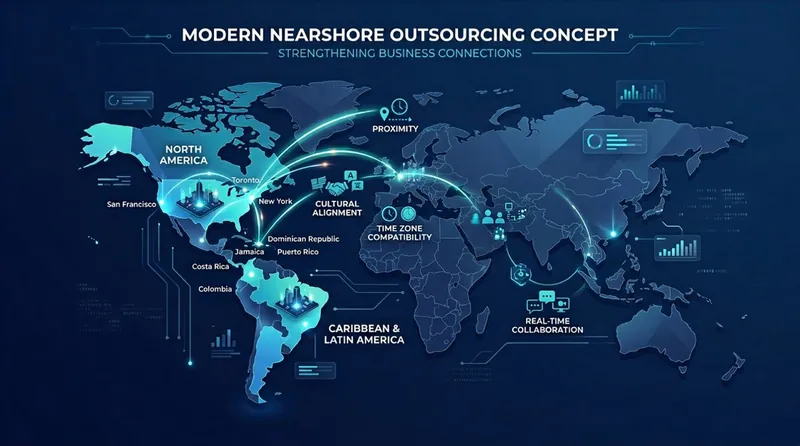
Quick Answer
Nearshore outsourcing is when a company hires an external team or service provider in a nearby country, typically one that shares a similar time zone, language, and cultural background. For US businesses, this usually means working with providers in the Caribbean, Mexico, or Central and South America.
Nearshore outsourcing is the practice of delegating business operations to companies in nearby countries that share similar time zones, cultural alignment, and geographic proximity. According to the Deloitte Global Outsourcing Survey, nearshore delivery has become one of the fastest-growing segments in outsourcing, driven by demand for real-time collaboration and cultural compatibility.
If you have spent any time researching outsourcing, you have probably encountered three terms used almost interchangeably: onshore, nearshore, and offshore. They sound like they describe the same thing with minor geographic differences, but the practical implications for your business are substantial. Understanding the distinction matters because it directly affects communication, cost, quality, and how much of your own time you will spend managing the relationship.
The Three Outsourcing Models: Nearshore vs Offshore vs Onshore
Onshore outsourcing means hiring a third-party provider within your own country. A US company working with a call center in Texas is outsourcing onshore. You get the same time zone, the same language, and the same cultural context. You also get the same labor costs, which is why onshore outsourcing delivers the smallest cost savings. According to Gartner, onshore outsourcing remains common in regulated industries where data residency and compliance requirements take priority over cost optimization. The Bureau of Labor Statistics tracks domestic wage data for customer service roles across the United States.
Nearshore outsourcing sends the work to a neighboring country or nearby region. For US companies, this means the Caribbean and Latin America. According to Nearshore Americas, the region has seen sustained growth in BPO investment as US companies prioritize time zone alignment and cultural proximity. The time zone overlap is close to complete, English proficiency is generally strong, and cultural familiarity with American consumers runs deep. Labor costs are meaningfully lower than domestic rates, though not as low as the most distant offshore markets. Our complete guide to nearshore call center outsourcing in the Caribbean covers the specific destinations, benefits, and provider selection criteria in detail.
Offshore outsourcing routes work to distant countries, often on the other side of the world. The Philippines and India are the most common offshore destinations for English-language services. According to Statista, the Philippines remains the world's largest voice-based outsourcing market by headcount. Per-hour rates are the lowest of the three models, but the time zone gap, cultural distance, and communication friction can create hidden costs that offset the rate advantage.
Nearshore vs Offshore vs Onshore Comparison Table
| Factor | Onshore (US) | Nearshore (Caribbean / LatAm) | Offshore (Philippines / India) |
|---|---|---|---|
| Typical Hourly Cost | $25 - $35/hr | $12 - $18/hr | $6 - $14/hr |
| Cost Savings vs Domestic | 0 - 15% | 40 - 60% | 60 - 75% |
| Time Zone Overlap | Full | Full or near-full (0 - 2 hr gap) | Minimal (8 - 12 hr gap) |
| English Proficiency | Native | Native to near-native | Varies widely |
| Cultural Alignment (US) | High | High | Low to moderate |
| Agent Attrition Rate | 30 - 40% annually | 20 - 35% annually | 40 - 60% annually |
| Management Overhead | Low | Low to moderate | High |
| Travel Accessibility | Easy (domestic flights) | Easy (2 - 4 hr flights) | Difficult (15+ hr flights) |
| Ramp-Up Speed | Fastest | Fast (1 - 2 weeks) | Slower (2 - 4 weeks) |
| Best For | Regulated industries, premium CX | Customer-facing voice, real-time support, bilingual programs | High-volume back-office, 24/7 follow-the-sun coverage |
The comparison becomes even more striking when you look at total cost of ownership rather than hourly rates alone. Offshore programs often appear cheaper on paper, but the hidden costs of higher attrition, longer ramp times, quality rework, and management overhead can erode those savings significantly. A $6 per hour offshore rate that requires 20% more management time and 40% more agent replacements often ends up costing the same as a $14 per hour nearshore rate with none of those headaches. For a detailed breakdown of how these costs add up, see our complete guide to call center outsourcing costs.
Why Nearshore Has Become the Default for US Companies
Nearshore outsourcing is the default because it delivers 40 to 60% cost savings with same-timezone operations and native English fluency.
Offshore outsourcing dominated the conversation for years because the cost savings were dramatic and easy to measure on a spreadsheet. But as companies gained experience with offshore programs, the hidden costs became harder to ignore. Calls that took longer because of accent barriers. Customer complaints about being transferred overseas. Management time consumed by overnight conference calls and asynchronous communication loops. Quality issues that took days to surface because no one was awake to catch them in real time.
Industry analysts note that the shift toward nearshore outsourcing reflects a broader market correction, as organizations move from cost-only decisions to total-value assessments that include quality, speed, and management overhead. According to the McKinsey Global Institute, companies that optimize for proximity and collaboration tend to see stronger outcomes in customer-facing operations than those focused solely on labor arbitrage.
Nearshore outsourcing emerged as the middle path that addresses most of these problems without giving up the cost advantage entirely. When your outsourcing partner is in Jamaica or Colombia instead of the Philippines, a few things change immediately.
Your teams can collaborate in real time. There is no waiting until tomorrow for an answer. If a problem surfaces at 2 PM Eastern, someone on the partner's team is at their desk, in the same part of their workday, ready to address it. This sounds basic, but for anyone who has managed an offshore relationship across a 12-hour gap, the difference is transformative.
The cultural overlap goes deeper than shared time zones. Caribbean and Latin American professionals consume US media, understand American consumer expectations, and often have personal connections to the United States through family, education, or travel. This familiarity translates directly into how agents interact with customers. They understand the references, the expectations, and the unspoken norms that shape a positive service experience.
And the economics work. According to the IAOP (International Association of Outsourcing Professionals), nearshore outsourcing to the Caribbean and Latin America saves 40 to 60% compared to domestic operations. For a company spending $1 million a year on in-house support, that means $400,000 to $600,000 in savings redirected to product, hiring, or growth. The gap with offshore rates narrows further when you factor in the management overhead, quality costs, and attrition expenses that offshore programs tend to generate.
Top Countries for Nearshore Outsourcing (US Companies)
Not all nearshore destinations are created equal. The best country for your operation depends on the type of work, language requirements, and the talent profile you need. Here is a country-by-country breakdown of the most popular nearshore outsourcing destinations for US businesses.
Caribbean Countries (English-Speaking, EST/AST Time Zone)
The Caribbean is the strongest nearshore option for US companies that need native English speakers for customer-facing voice operations. These countries share deep cultural ties with the United States, and the time zone alignment is nearly perfect for East Coast and Central Time business hours.
Jamaica
Jamaica is the Caribbean's largest and most established BPO market, with over 40,000 workers in the outsourcing sector. Jamaican agents are known for warm, natural communication styles with neutral accents that American callers find easy to understand. The country has invested heavily in BPO infrastructure, with multiple free-zone technology parks and a government-backed training pipeline. Jamaica's proximity to the US - just a 3-hour flight from Miami - makes it easy to visit operations and build strong working relationships. It is especially strong for sales, customer service, and insurance-related call center work.
Trinidad and Tobago
Trinidad and Tobago offers a highly educated English-speaking workforce with strong representation in finance, energy, and technology sectors. The twin-island nation benefits from one of the Caribbean's most diversified economies, which produces candidates with solid analytical and technical skills. The AST time zone puts Trinidad just one hour ahead of US Eastern Time, maintaining excellent overlap for real-time collaboration. It is a particularly good fit for technical support, financial services, and back-office processing operations that require attention to detail.
Guyana
Guyana is South America's only English-speaking country, giving it a unique advantage as a nearshore destination. The country's rapidly growing economy - driven by new energy sector investments - has expanded its professional workforce and improved digital infrastructure. Guyana offers some of the most competitive labor rates in the English-speaking Caribbean while maintaining the same time zone alignment and cultural familiarity. It is an emerging option for companies looking to combine Caribbean-quality English with lower cost points, particularly for customer service and data processing roles.
Latin American Countries (Bilingual, CST/EST Time Zones)
Latin American nearshore destinations are ideal for bilingual English-Spanish programs, back-office operations, and tech-focused outsourcing. These countries offer large talent pools, competitive rates, and strong educational systems, though English proficiency levels vary more than in the Caribbean.
Colombia
Colombia has become one of Latin America's fastest-growing outsourcing destinations, with cities like Bogota, Medellin, and Barranquilla developing substantial BPO clusters. The country's bilingual workforce exceeds 600,000 BPO employees, giving it the scale to staff programs of 100 or more agents from a single metro area. The country shares the US Eastern time zone, has a large young workforce, and has invested significantly in English-language education programs. Colombian agents are known for clear, neutral Spanish and increasingly strong English skills. Colombia is particularly competitive for bilingual customer service, tech support, and software development outsourcing. Industry rates tend to run 10 to 20% lower than Caribbean English-speaking markets.
Mexico
Mexico is the closest major nearshore market to the United States, sharing a land border and benefiting from USMCA trade alignment. It offers the largest available labor pool of any nearshore destination, with well-established BPO hubs in Monterrey, Guadalajara, Mexico City, and Tijuana. Mexico excels at bilingual English-Spanish programs and is the top choice for companies that need to serve both English and Spanish-speaking US customers from a single location. The border cities offer the additional advantage of same-day travel from many US metro areas.
Costa Rica
Costa Rica has the longest track record in Latin American BPO, with major multinationals like Amazon, HP, and Intel operating service centers in the country for over two decades. It ranks consistently among the most politically stable and highly educated nations in Latin America, with a literacy rate above 97%. Costa Rica's English proficiency levels are among the highest in the region, and the country produces a steady pipeline of bilingual graduates. Rates are slightly higher than Colombia or Mexico, but the quality and stability often justify the premium, especially for complex customer service and healthcare outsourcing operations.
Choosing the Right Country
For English-language voice operations where accent clarity and cultural alignment are the top priorities, Caribbean countries like Jamaica and Trinidad are the strongest fit. For bilingual programs or larger-scale operations, Colombia, Mexico, and Costa Rica offer deeper talent pools. Many companies use a blended approach - Caribbean agents for English-only programs and Latin American agents for bilingual or back-office work. Our guide to choosing a BPO partner covers the evaluation criteria in detail.
How Nearshore Outsourcing Works in Practice
Nearshore outsourcing works through discovery, agent hiring, 2 to 4 weeks of training, a controlled pilot, then full go-live with same-timezone oversight.
Understanding the theory behind nearshore outsourcing is useful, but what does the day-to-day reality look like? Here is what a typical nearshore engagement involves from start to finish.
Discovery and scoping. You define the work you want to outsource - whether that is inbound customer service, outbound sales, technical support, or back-office processing. You share your call volumes, quality expectations, technology stack, and compliance requirements. The nearshore provider uses this to build a staffing plan, propose pricing, and define service level agreements (SLAs).
Agent recruitment and training. The provider recruits agents that match your requirements for language, skills, and experience. Training typically takes one to two weeks, depending on the complexity of your program. Because nearshore agents share your time zone, training sessions can happen live and in real time - no recordings or overnight handoffs needed.
Go-live and ramp. Agents begin handling live work, usually starting at reduced volume and scaling up over the first few weeks. Your team and the nearshore team are online at the same hours, which means issues surface fast and get resolved fast. This is one of the most underappreciated advantages of nearshore - the speed of the feedback loop during ramp is dramatically faster than with offshore teams working opposite hours.
Ongoing management. Daily or weekly syncs happen during normal business hours. Quality reviews, coaching sessions, and performance discussions all happen in real time. If you are using a provider in Jamaica or Colombia, you can even visit the operation with a short direct flight - something that is impractical with offshore partners on the other side of the world.
Common Risks of Nearshore Outsourcing (and How to Manage Them)
Nearshore outsourcing is not without risks. Being aware of potential challenges upfront helps you plan around them and choose the right provider.
- Smaller talent pools. Caribbean and Central American markets are smaller than India or the Philippines. This can be a constraint if you need to scale to hundreds of agents quickly. The solution is to work with providers who recruit across multiple nearshore countries or to use a blended nearshore-offshore model for very large programs.
- Infrastructure variability. Internet connectivity and power reliability can vary by location within nearshore countries. Established BPO providers mitigate this with redundant internet connections, backup power, and work-from-home setups with minimum connectivity requirements.
- Slightly higher rates than offshore. Nearshore rates of $12 to $18 per hour are higher than the $6 to $14 you might pay offshore. However, total cost of ownership - factoring in attrition, quality rework, and management time - often makes nearshore comparable or better. See our cost analysis for the full breakdown.
- Data security and compliance. As with any outsourcing model, you need to verify that your provider meets your data security and compliance standards. Look for providers with SOC 2 compliance, clear data handling policies, and experience in your regulatory environment. Healthcare and insurance operations require extra scrutiny here.
- Vendor dependency. Over-reliance on a single provider creates business continuity risk. Consider splitting volume across two nearshore providers or maintaining a small onshore team as a backup, especially for critical customer-facing programs.
Is Nearshore Right for Your Business?
Nearshore outsourcing fits best when your customers are US-based, English-speaking, and you need real-time collaboration with cost savings of 40 to 60%.
Nearshore outsourcing tends to be the strongest fit when your customers are primarily English-speaking and based in US time zones, when real-time collaboration between your team and the outsourced team is important, when customer experience quality is a priority rather than just cost minimization, and when you want meaningful savings without taking on the management complexity of an offshore relationship. Industries with high compliance and communication standards, such as healthcare outsourcing and insurance operations, benefit especially from the nearshore model because of the cultural alignment and real-time oversight it enables. The U.S. Small Business Administration offers guidance on evaluating vendor relationships and data security practices that can help companies vet nearshore partners.
Offshore may still make more sense if your primary goal is absolute lowest per-hour cost, if your operation runs 24/7 and benefits from follow-the-sun coverage across multiple time zones, or if the work is highly process-driven with minimal real-time collaboration needs. Not sure which model fits? Our nearshore vs. offshore vs. onshore comparison breaks down the trade-offs side by side.
For the majority of US companies outsourcing customer-facing operations, nearshore delivers the best balance of cost, quality, and operational simplicity. That is why it has become the fastest-growing segment of the outsourcing market. If you are weighing the in-house vs outsourced call center decision, nearshore often represents the best of both worlds - external cost efficiency with domestic-quality communication.
Frequently Asked Questions
What is the difference between nearshore and offshore outsourcing?
The core difference is geographic proximity and the downstream effects it creates. Nearshore outsourcing uses providers in nearby countries with overlapping time zones - for a US company, that means the Caribbean, Mexico, or Central and South America. Offshore outsourcing uses providers in distant countries like the Philippines or India, typically with an 8 to 12 hour time zone gap. Nearshore rates generally run $12 to $18 per hour versus $6 to $14 offshore, but nearshore delivers easier real-time communication, stronger cultural alignment, lower attrition, and less management overhead - which often makes total cost of ownership comparable.
What countries are considered nearshore for the US?
For US companies, nearshore countries include the Caribbean nations of Jamaica, Trinidad and Tobago, Guyana, and Barbados (all English-speaking in EST or AST time zones), as well as Latin American countries like Colombia, Mexico, and Costa Rica (bilingual talent pools in CST or EST). The Caribbean is strongest for English-language voice operations due to native fluency and deep American cultural familiarity, while Latin American destinations excel at bilingual programs and back-office services.
How much does nearshore outsourcing cost?
Industry data shows nearshore outsourcing rates for US companies typically range from $12 to $18 per hour for call center and customer service roles, compared to $25 to $35 per hour for equivalent domestic operations. This translates to savings of 40 to 60% compared to onshore. While offshore rates can start at $6 to $14 per hour, nearshore often delivers better total cost of ownership when you factor in quality, attrition, rework, and management overhead. The exact rate depends on the country, the complexity of the work, and the provider. See our full cost guide for detailed breakdowns.
Is nearshore outsourcing better than offshore?
For customer-facing operations, English-language voice programs, and any work that requires real-time collaboration, nearshore is generally the better choice. The time zone alignment, cultural proximity, and language quality create measurably better customer experiences with less management effort. Offshore may still be better for high-volume back-office processing, 24/7 follow-the-sun coverage models, or operations where the absolute lowest per-hour rate is the top priority. Most companies find that nearshore delivers the best overall balance of cost, quality, and operational simplicity for customer-facing work.
What are the risks of nearshore outsourcing?
The primary risks include smaller talent pools compared to large offshore markets like India or the Philippines, slightly higher hourly rates than offshore providers, potential infrastructure variability in some Caribbean and Latin American markets, and the standard outsourcing risks of vendor dependency and data security. These risks are manageable with proper due diligence - choosing providers with proven infrastructure, clear SLAs, and strong data security practices. For most US companies, the risks of nearshore are significantly lower than offshore because proximity makes oversight and quality management far easier.
What is nearshore outsourcing?
Nearshore outsourcing is the practice of hiring an external team or company in a neighboring country or nearby region, typically within the same or a similar time zone. For US companies, this usually means working with providers in the Caribbean, Mexico, or Central and South America. It offers a middle ground between the cost savings of offshore outsourcing and the proximity of domestic operations. The model is especially popular for customer service, sales, and technical support operations where real-time communication and cultural alignment matter.
Considering Nearshore Outsourcing?
We operate across the Caribbean with agents who share your time zone, speak your language, and understand your customers. Tell us about your operation and we will show you what nearshore can look like for your business.