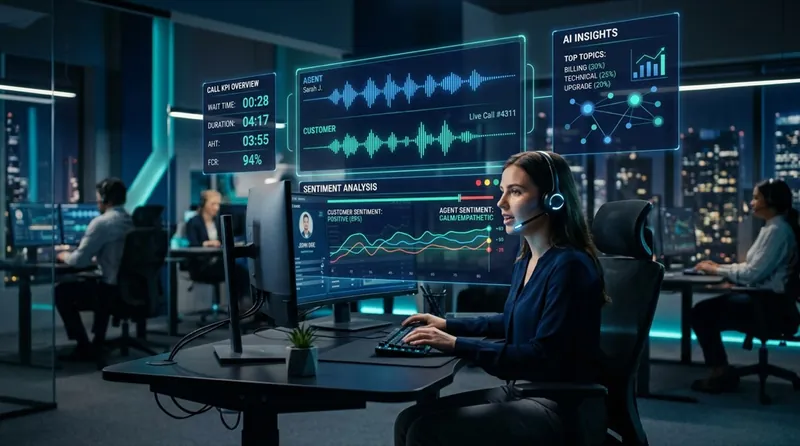
AI is not replacing call center agents -- it is making them faster, more consistent, and better informed by handling routine tasks while humans focus on complex and emotional interactions. Here is what that actually looks like in practice, separated from the hype.
Every conference, webinar, and industry report in the BPO world right now opens with the same premise: AI is going to transform call centers. And it is true. AI is already changing how call center operations run, from the way calls get routed to how quality gets measured to what agents see on their screens during a conversation. But the transformation looks nothing like the headlines suggest.
The dominant narrative is that AI will replace human agents. That chatbots and voice bots will handle customer interactions end to end, and that the traditional call center model is headed for obsolescence. If you are a business leader evaluating your customer service strategy, this narrative is misleading. It confuses what is technically possible in a controlled demo with what actually works at scale when real customers call with real problems and real emotions.
Here is what is actually happening, what is working, what is not, and what it means for companies deciding how to structure their customer service operations going forward.
What AI Actually Does Well in Call Centers Right Now
AI excels at real-time agent assist, automated quality assurance on 100% of calls, intelligent call routing, and post-call summarization.
According to Gartner's research on customer service technology, the most impactful AI applications in call centers today are not customer-facing. They sit behind the scenes, making human agents faster, more consistent, and better informed. That distinction matters because it changes the entire calculus of how you think about AI in your customer service strategy.
Real-Time Agent Assist
This is arguably the most valuable AI application in modern call centers. Agent assist tools listen to conversations in real time and surface relevant information on the agent's screen. When a customer describes a problem, the AI searches knowledge bases, previous interaction history, and product documentation to pull up the most likely answer or resolution path. The agent still makes the decision and communicates with the customer, but they spend dramatically less time searching for information.
The impact is meaningful. Agents with real-time assist tools resolve calls faster because they are not hunting through multiple systems for answers. They provide more accurate information because the AI is pulling from the same knowledge base rather than relying on memory. And newer agents ramp up to competency faster because the AI acts as a persistent training partner that surfaces relevant guidance based on the actual conversation happening in the moment.
Automated Quality Assurance
Traditional call center QA involves supervisors or quality analysts manually reviewing a sample of calls, as noted by the Bureau of Labor Statistics in its overview of customer service industry practices. In most operations, that sample is somewhere around 2 to 5% of total call volume. The math is brutal: you are making quality decisions based on a tiny sliver of what actually happens, and the calls you review may not be representative of the whole. For a 50-agent team handling 5,000 calls a day, a 3% QA sample means 4,850 calls go completely unreviewed.
According to Deloitte's research on AI in contact centers, the shift from sample-based to comprehensive quality evaluation represents one of the most significant operational improvements AI has delivered to the BPO industry. AI-powered QA changes that equation entirely. Natural language processing and speech analytics can evaluate every single call against your quality criteria. Did the agent use the required greeting? Did they verify the customer's identity? Did they offer the right resolution? Did the tone remain professional throughout? AI can flag calls that fall outside acceptable parameters, identify trending issues, and give supervisors a comprehensive view of quality across the entire operation rather than a statistical guess based on random samples.
For companies outsourcing their call center operations, AI-powered QA is particularly valuable. It gives you visibility into the quality of every interaction your BPO partner handles, not just the handpicked examples they include in weekly reports.
Intelligent Call Routing
Traditional call routing is based on simple rules: press 1 for billing, press 2 for support. AI-powered routing is more sophisticated. It can analyze the caller's history, the nature of their previous interactions, their account status, and even the words they use when describing their issue to route them to the agent best suited to handle their specific situation.
Some systems go further, matching caller personality profiles with agent communication styles. A caller who is direct and just wants their problem fixed quickly gets routed to an agent who excels at efficient, no-nonsense resolutions. A caller who is upset and needs to feel heard gets matched with an agent who scores highest on empathy and active listening. The practical result is higher first-call resolution rates and better customer satisfaction scores, achieved through better matching rather than any change to how agents actually handle calls. Even a 5% improvement in FCR eliminates thousands of repeat calls per month on a mid-size operation, which directly lowers cost per resolution.
Post-Call Automation
After every call, agents spend time writing notes, updating records, and categorizing the interaction. This after-call work typically adds 30 to 90 seconds to every interaction and is one of the most tedious parts of the job. AI-powered summarization tools can listen to the call and automatically generate an accurate summary, update the CRM record, and categorize the interaction type. The agent reviews and approves the summary rather than writing it from scratch.
This sounds like a small improvement, but the compounding effect is significant. Across a team of 50 agents handling 100 calls each per day, saving even 30 seconds per call reclaims over 40 hours of productive time per day. At a nearshore rate of $15 per hour, that is $600 a day in recovered capacity, or roughly $156,000 a year, from a single automation. That is real capacity that can be redirected toward handling more calls, spending more time on complex issues, or reducing overtime. For companies focused on scaling support operations, this kind of efficiency gain is exactly how AI makes growth manageable without proportionally growing headcount.
Where AI Falls Short
AI falls short on complex multi-layered problem solving, genuine emotional intelligence, and sales conversations requiring real-time persuasion.
For all its genuine capabilities, AI has clear limitations in the call center context that are important to understand honestly.
Complex Problem Solving
When a customer calls with a straightforward, well-defined issue, AI can often resolve it or help an agent resolve it quickly. But many customer interactions are not straightforward. The customer's billing issue is tangled up with a service change they made three months ago, a promotional rate that expired, and a partial refund that was applied incorrectly. Untangling that kind of multi-layered problem requires reasoning, investigation, and judgment that current AI systems cannot reliably provide.
AI is excellent at pattern matching and information retrieval. It is not good at navigating ambiguity, making judgment calls about exceptions to policy, or figuring out the right course of action when the situation does not fit neatly into documented procedures. Those capabilities remain distinctly human. The National Institute of Standards and Technology (NIST) has published frameworks for evaluating AI capabilities and limitations that are worth reviewing when assessing AI-powered tools in any business context.
Emotional Intelligence
A customer calling to file an insurance claim after their house flooded is not looking for efficient information retrieval. They need someone who understands what they are going through, who can acknowledge the difficulty of the situation, and who can guide them through the process with genuine warmth and patience. AI can detect sentiment. It can identify that a caller is upset. But it cannot care, and customers can tell the difference.
This limitation is not going away soon. Empathy is not a pattern-matching problem. It requires genuine human connection, cultural understanding, and the kind of emotional intelligence that comes from lived experience. The BPO providers getting the best results are the ones who recognize this and use AI to handle the mechanical work so their human agents have more time and energy for the interactions that require real emotional engagement.
Sales and Persuasion
Outbound sales, upselling, cross-selling, and retention conversations all require a type of interpersonal skill that AI cannot replicate. Reading a prospect's hesitation, adjusting the pitch in real time, building rapport, overcoming objections with authentic responses, and knowing when to push and when to back off are deeply human skills. AI can support sales agents with relevant product information, pricing, and customer history. But the actual selling is a human craft.
The Bottom Line
AI is not replacing human call center agents. It is reshaping the work they do. The routine, repetitive, information-retrieval tasks are being automated. The complex, emotional, and relationship-driven work is becoming more important, not less. The best call center operations in 2026 are the ones that deploy AI to eliminate busywork and free their human agents to do what humans do best.
What This Means for Outsourcing Decisions
AI makes BPO partnerships more valuable, not less. Choose providers that use AI to augment agents rather than replace them.
Industry analysts note that the BPO providers delivering the strongest outcomes are those treating AI as an agent enablement tool rather than an agent replacement strategy, investing in technology that amplifies human capabilities instead of attempting to eliminate them.
According to McKinsey's research on AI in customer operations, organizations that deploy AI to augment rather than replace human agents consistently report better customer satisfaction outcomes than those pursuing full automation. Everest Group's analysis of contact center AI adoption has reached similar conclusions, finding that hybrid human-AI models outperform either approach in isolation. If you are evaluating BPO partners right now, AI should be part of the conversation. Not because you need a partner with the flashiest technology, but because their approach to AI tells you a lot about how they think about operations, quality, and continuous improvement.
A BPO provider that has invested in AI-powered quality assurance is telling you they care about monitoring every interaction, not just a random sample. A provider using real-time agent assist tools is showing you they are investing in agent performance and faster resolution times. A provider with intelligent routing is demonstrating that they think carefully about matching callers with the right agent rather than just distributing calls evenly.
These are not nice-to-have features. They translate directly into better customer experiences, higher first-call resolution, and more efficient operations. When you look at the full cost analysis of call center outsourcing, AI-augmented operations consistently deliver stronger ROI because they get more value out of every agent hour. This is especially true in compliance-heavy verticals like healthcare call center outsourcing and insurance call center outsourcing, where AI-powered QA catches regulatory missteps that human reviewers sampling 2-5% of calls would miss. Before selecting any BPO in these industries, our call center compliance checklist covers the specific requirements to verify before you sign. The same principle applies to SaaS customer support outsourcing, where AI-driven ticket triage and knowledge base surfacing dramatically improve resolution speed. And critically, they are capabilities that most companies cannot cost-effectively build and maintain on their own. The AI tooling, the data infrastructure to power it, and the expertise to implement and tune it are all things that BPO providers can amortize across their client base, making advanced AI capabilities accessible to companies of all sizes through their outsourcing partnership.
When choosing a BPO partner, ask specific questions about their AI capabilities. What AI tools do your agents use during calls? How do you measure the impact of those tools on performance metrics? What percentage of calls does your QA system evaluate? Can you share before-and-after data showing the impact of AI on handle times, resolution rates, or customer satisfaction? The answers will tell you whether their AI investment is substantive or superficial.
The Human Premium in an AI World
BPO leaders emphasize that the value of a skilled human agent is actually increasing in an AI-augmented environment, because the interactions that reach a person are inherently more complex and consequential than they were before AI handled the simple ones.
There is an irony in the AI conversation that the BPO industry is just starting to grapple with. As AI handles more routine interactions, the calls that reach human agents become harder, more emotional, and more consequential. The easy calls get deflected by self-service and chatbots. What remains is the complex stuff, the upset customers, the unusual situations, and the high-stakes conversations where getting it right really matters.
This shifts the profile of what a good call center agent looks like. Technical proficiency with systems matters less when AI handles the information retrieval. What matters more is communication skill, emotional intelligence, problem-solving ability, and the kind of cultural alignment that lets an agent connect genuinely with the customer on the other end of the line. Companies that invest in these human qualities also see measurably lower call center attrition, because agents handling meaningful work are more engaged and less likely to leave.
For companies outsourcing to nearshore partners in the Caribbean -- and if you are new to what nearshore outsourcing means, it is worth understanding the differences between nearshore vs. offshore vs. onshore models -- this dynamic plays to their advantage. The Caribbean talent pool is strong precisely in the areas that matter most in an AI-augmented environment: native English fluency, cultural alignment with US consumers, natural warmth and communication style, and the kind of genuine empathy that comes from shared cultural context. AI handles the mechanical work. Caribbean agents bring the human element that makes the customer feel heard, understood, and cared for. The growing number of remote call center opportunities in the Caribbean is a direct reflection of this demand for talent that combines technical adaptability with genuine interpersonal warmth.
Looking Ahead
AI in call centers is going to keep evolving. Voice bots will get better at handling simple interactions. Agent assist tools will become more context-aware and proactive. QA systems will move from evaluation to real-time coaching, giving agents feedback during the call rather than after. Predictive analytics will get more accurate at forecasting volume, identifying at-risk customers, and surfacing opportunities for proactive outreach.
But the fundamental dynamic is unlikely to change. Customer service at its core is a human activity. People call because they have a problem they could not solve on their own, and they want to talk to someone who can help. The technology that surrounds that interaction will keep improving. The need for skilled, empathetic, competent human agents will not go away.
The companies that will get the most value from AI in their call center operations are not the ones chasing full automation. They are the ones building operations where AI and human agents complement each other, where technology handles the routine so people can focus on the meaningful, and where the quality of the human interaction is treated as the competitive advantage it has always been.
Frequently Asked Questions
Will AI replace call center agents?
AI is not replacing call center agents wholesale. It is changing what agents spend their time on. Routine, repetitive inquiries like password resets, order status checks, and simple account updates are increasingly handled by AI-powered self-service. But complex problem-solving, emotionally sensitive conversations, sales persuasion, and relationship building remain firmly in human territory. The industry trend is toward AI handling the simple volume so human agents can focus on higher-value interactions.
How are BPO companies using AI today?
Leading BPO providers use AI across several areas: real-time agent assist tools that surface relevant information during calls, automated quality assurance that scores every call instead of random samples, predictive workforce management that forecasts volume more accurately, intelligent routing that matches callers with the best-suited agent, post-call summarization that eliminates manual note-taking, and sentiment analysis that flags at-risk interactions for supervisor attention.
Does AI in call centers improve customer satisfaction?
When implemented thoughtfully, yes. AI reduces wait times through better self-service and smarter routing, gives agents instant access to relevant information so they can resolve issues faster, and ensures consistent quality through automated monitoring. The key word is thoughtfully. Poorly implemented AI, like chatbots that cannot understand customer intent or IVR systems that trap people in loops, will hurt satisfaction. The technology works best when it supports human agents rather than attempting to replace them entirely.
Should I choose a BPO partner based on their AI capabilities?
AI capabilities should be one factor in your evaluation, but not the primary one. A BPO partner with excellent agents, strong training, and proven quality processes will outperform one with flashy AI tools but weak fundamentals. That said, providers who are investing in AI-powered quality assurance, agent assist, and workforce management are signaling that they are forward-looking and committed to continuous improvement. Ask about their specific AI implementations and the measurable results they have achieved rather than accepting broad claims about AI readiness.
How much does AI cost in a call center outsourcing contract?
Most progressive BPO providers include AI-powered tools in their standard service delivery without charging separately. Agent assist, automated QA, and intelligent routing are increasingly considered baseline capabilities rather than premium add-ons. Some specialized AI services like custom chatbot development, advanced analytics dashboards, or voice biometrics may carry additional costs. Ask your provider which AI tools are included in their standard rate and which are priced separately.
AI-powered, human-driven
See Our Approach to AI-Augmented Support
We combine AI-powered quality assurance and agent assist tools with skilled Caribbean agents who bring the human element your customers actually want.