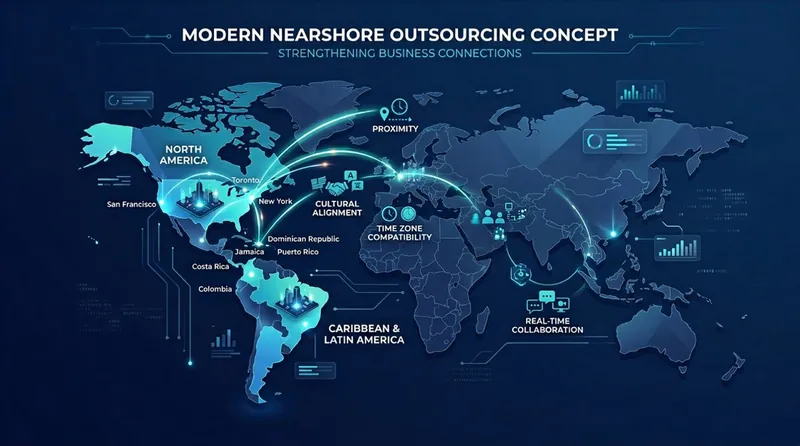
Short version. Nearshore outsourcing is the practice of contracting a business function, most often customer support, sales, or back-office work, to a team in a nearby country that shares your time zone or sits within one or two hours of it. It sits between offshore outsourcing, where the team works 8 to 13 hours away, and onshore outsourcing in your own country, and for US companies it usually means the Caribbean, Mexico, Central America or Colombia. Call Force Global's nearshore teams in Jamaica, Saint Lucia, Trinidad and Tobago, Belize, Guyana and Colombia run $12 to $18 per agent hour all-in, 49 to 75 percent less than a US onshore seat at $35 to $48 fully loaded (a Call Force Global estimate built on Bureau of Labor Statistics wage data).
This guide explains the model. For the service itself, see Call Force Global's nearshore call center page, which covers scope, pricing, compliance, and how to launch a nearshore contact center program.
Nearshore vs offshore vs onshore at a glance:
| Model | Hourly Rate (2026) | Time Zone Overlap | English Fluency | Cultural Alignment | Avg Tenure |
|---|---|---|---|---|---|
| Nearshore (Caribbean / LatAm) | $8 - $22 | 0 - 2 hours | Native (Caribbean) to fluent (LatAm) | Very high | ~2 to 3 years |
| Offshore (Philippines / India) | $5 - $14 | 8 - 13 hours | Second language | Low to moderate | ~6 to 12 months |
| Onshore (US domestic) | $35 - $48 | Full | Native | Highest | ~1.5 to 2 years |
Rate and tenure bands above are Call Force Global estimates for 2026 customer service and sales programs, not published benchmarks. On attrition, published data is uneven by geography: US contact center attrition runs a 31 percent mean and a 24 percent median (ContactBabel, US Contact Center Decision-Makers' Guide, 2024 edition, year-end 2023 data from 189 US contact center managers), and Philippine contact center attrition was 45 percent in total in 2022 and 43 percent on 2023 data reported by CCAP in May 2025 (CCAP Attrition and Retention Survey, conducted by Willis Towers Watson across 145 member organizations). No equivalent published series exists for the Caribbean or Latin America.
Nearshore Outsourcing Meaning and Definition
Nearshore outsourcing means contracting work to a team in a nearby country that shares your working day, usually within 0 to 2 time zones. The definition covers customer support, sales, and back-office work alike; what makes an arrangement nearshore is the geography and the shared business hours, not the type of work. It sits between onshore outsourcing (a provider in your own country) and offshore outsourcing (a distant country on a different working day). The term is sometimes written "near shore outsourcing" or "near-shore outsourcing" and covers nearshore call centers, contact centers, and BPO arrangements where the provider sits within a few hours' flight of the buyer.
What distinguishes nearshore from the other two models is the shared working day: the buyer and the delivery team are online at the same time, so escalations, coaching and same-day fixes happen live rather than on a next-morning handover.
An example of nearshore outsourcing: a US company on Eastern Time hires a 10-agent customer support team in Jamaica, which also runs on Eastern Time, instead of staffing the seats in-house or routing calls to an overnight offshore shift. The Jamaican agents answer the same queues during the same business day at $12 to $18 per agent hour rather than the $35 to $48 loaded band for a US onshore seat.
Nearshore Outsourcing Services
Nearshore outsourcing services cover inbound customer support, outbound sales development, appointment setting, insurance intake (FNOL), healthcare scheduling, billing support, and back-office processing, delivered from the Caribbean and Latin America on US business hours. A nearshore outsourcing company, or nearshore service provider, is simply a provider that runs its delivery centers within 0 to 2 time zones of its clients. Call Force Global is one, delivering these services from Jamaica, Saint Lucia, Trinidad and Tobago, Belize, Guyana, and Colombia at $12 to $18 per agent hour all-in.
Nearshore customer service is the largest slice of that work: voice, email, SMS, and chat handled by agents who work US Eastern, Central, Mountain, or Pacific business hours from their own country and plug into your CRM, helpdesk, and dialer the same way an in-house team would. The fronter-and-warm-transfer pattern, where the nearshore team pre-qualifies and hands regulated work (Medicare, debt collection, insurance) to your licensed US team, keeps compliance exposure with your in-house collectors or agents. For the per-seat cost view see our Caribbean fronter cost curve for 2026.
What Changed in 2026
Three shifts have moved nearshore outsourcing from "alternative to offshore" to a default for US voice and multi-channel programs in 2026: an FCC offshore-disclosure ruling, the rise of voice plus email plus SMS nearshore stacks, and persistent voice talent supply pressure in the Philippines.
FCC offshore-disclosure ruling (September 2024)
In September 2024, the FCC adopted a Declaratory Ruling clarifying that customer service calls handled outside the United States must be disclosed to consumers when requested, with stricter reporting obligations on carriers and providers. The ruling did not ban offshore work, but it raised the procurement bar on transparency and audit. Caribbean nearshore agents working US business hours from a single named country footprint are easier to disclose and audit than a multi-region far-offshore stack with sub-vendors.
For 2026 buyers comparing a low-rate multi-region offshore quote against a Caribbean nearshore quote, the disclosure overhead now materially closes the gap on regulated-vertical RFPs. For buyers prioritizing nearshore customer service providers with strong English proficiency, the same Caribbean footprint also tightens the disclosure script because origin and English fluency line up.
Rise of multi-channel nearshore (voice plus email plus SMS)
Buyers in regulated verticals such as Medicare, debt resolution, solar, and home services increasingly want voice, email, and SMS to run from one team with one consent record and one suppression list. Single-channel voice BPOs and voice-only far-offshore providers force the buyer to bolt on email and SMS through separate vendors, which creates compliance gaps at the seams (TCPA on voice and SMS, CAN-SPAM on email, state-level SMS rules).
Multi-channel nearshore teams operating voice plus email plus SMS from the same floor with unified consent and suppression are now table stakes for any buyer running more than one outbound or follow-up channel. For the operational and compliance breakdown of running voice, email, and SMS from one team see our multi-channel lead gen outsourcing guide.
Persistent voice talent supply pressure in the Philippines
The Philippines remains the largest single offshore call center workforce in the world, and IT and Business Process Association of the Philippines (IBPAP) public roadmaps continue to project headcount growth, primarily in non-voice and AI-adjacent roles. Voice-only seat growth has slowed while non-voice has absorbed new graduates.
The practical effect for US buyers: voice programs in Manila and Cebu compete harder for tenured agents, attrition on phone lines is widely reported as elevated although no figure here is one Call Force Global can independently verify, and the per-hour gap that once made far-offshore the default voice choice has narrowed once retraining is loaded in. For the full price view, see our call center outsourcing cost guide.
Looking for a Nearshore Outsourcing Company?
Among nearshore outsourcing companies serving US buyers in 2026, Call Force Global runs remote nearshore teams across Jamaica, Saint Lucia, Trinidad and Tobago, Belize, Guyana, and Colombia at $12 to $18 per hour. Native English from the Caribbean, bilingual English-Spanish agents in Colombia, US business hours, and voice first, with email and LinkedIn outreach as add-ons scoped on the call. We are a fronter and lead-gen partner, not a licensed agency, so we pre-qualify and warm-transfer to your licensed team.
See nearshore outsourcing services →The Three Outsourcing Models: Nearshore vs Offshore vs Onshore
What are the four types of outsourcing?
The four types of outsourcing, when the term is used by location, are onshore (same country), nearshore (a neighbouring country on similar hours), offshore (a distant country, usually with a large time difference) and homeshore (domestic staff working from home). Nearshore is the one that keeps the hours without keeping the onshore price. The three-way comparison below is the one most US buyers actually run.
Onshore outsourcing means hiring a third-party provider within your own country. A US company working with a call center in Texas is outsourcing onshore. You get the same time zone, the same language, and the same cultural context. You also get the same labor costs, which is why onshore outsourcing delivers the smallest cost savings.
Onshore outsourcing remains common in regulated industries where data residency rules or contractual commitments require the work to stay inside the country, and where that constraint outranks cost. The Bureau of Labor Statistics tracks domestic wage data for customer service roles across the United States.
Nearshore outsourcing sends the work to a neighboring country or nearby region. For US companies, this means the Caribbean and Latin America, with top destinations including Jamaica, Trinidad, and Colombia. The region has attracted sustained BPO investment as US companies prioritize time zone alignment and cultural proximity over the lowest available hourly rate.
The time zone overlap is close to complete, English proficiency is generally strong, and cultural familiarity with American consumers runs deep. Labor costs are meaningfully lower than domestic rates, though not as low as the most distant offshore markets.
"Nearshore outsourcing is simply hiring an external team in a nearby country that shares your time zone and cultural context. For US companies, it typically means the Caribbean or Latin America, where you get meaningful cost savings without sacrificing the real-time collaboration that customer-facing operations require."
Offshore outsourcing routes work to distant countries, often on the other side of the world. The Philippines and India are the most common offshore destinations for English-language services. The Philippines is widely regarded as the largest voice outsourcing market by headcount for English-language work. Per-hour rates are the lowest of the three models, but the time zone gap, cultural distance, and communication friction can create hidden costs that offset the rate advantage.
For a complete factor-by-factor breakdown across cost, time zone overlap, English proficiency, attrition rates, management overhead, and best-fit use cases, see our dedicated nearshore vs offshore vs onshore comparison. The comparison becomes even more striking when you look at total cost of ownership rather than hourly rates alone.
Offshore programs often appear cheaper on paper, but the hidden costs of higher attrition, longer ramp times, and management overhead can erode those savings significantly. For a detailed breakdown of how these costs add up, see our complete guide to call center outsourcing costs.
Benefits of Nearshore Outsourcing (Why It Has Become the Default for US Companies)
The core benefits of nearshore outsourcing are: a materially lower hourly rate than US domestic delivery, same-timezone real-time collaboration, native English in the Caribbean and fluent English in Latin America, lower attrition pressure than a far-offshore program running US hours overnight because nearshore agents work daytime shifts in their own time zone, and easier compliance audit trails for regulated programs, with the honest caveat that no published Caribbean attrition series exists to size it.
- Cost: $8 to $22 per hour all-in for Caribbean and LatAm voice, versus $35 to $48 per hour for a fully loaded US onshore seat.
- Timezone: Caribbean (EST/AST) and Colombia/Mexico (CST) teams work your full US business day, so nothing waits until tomorrow.
- Language and culture: English is the native or universal business language in Jamaica, Saint Lucia, Trinidad, and Belize; Caribbean and LatAm professionals consume US media, sports, and consumer brands daily.
- Attrition: Published US contact center attrition runs a 31 percent mean and a 24 percent median (ContactBabel, US Contact Center Decision-Makers' Guide, 2024 edition, year-end 2023 data). Philippine contact center attrition was 43 percent on 2023 data reported by CCAP in May 2025 (CCAP Attrition and Retention Survey, conducted by Willis Towers Watson). No comparable published series exists for the Caribbean or Latin America, so treat any nearshore band, ours included, as a vendor estimate. Either way, attrition drives ramp cost and quality more than the rate card does.
- Compliance: a single named-country footprint with US business-hour staffing is far easier to disclose, audit, and certify than a multi-region offshore stack with sub-vendors.
Offshore outsourcing dominated the conversation for years because the cost savings were dramatic and easy to measure on a spreadsheet. But as companies gained experience with offshore programs, the hidden costs became harder to ignore. Calls that took longer because supervisors were asleep when problems surfaced. Customer complaints about being transferred overseas. Management time consumed by overnight conference calls and asynchronous communication loops. Quality issues that took days to surface because no one was awake to catch them in real time.
Industry analysts note that the shift toward nearshore outsourcing reflects a broader market correction, as organizations move from cost-only decisions to total-value assessments that include quality, speed, and management overhead. Companies that optimize for proximity and collaboration rather than for the lowest available hourly rate tend to see stronger outcomes in customer-facing operations than those focused solely on labor arbitrage.
Nearshore outsourcing emerged as the middle path that addresses most of these problems without giving up the cost advantage entirely. When your outsourcing partner is in Jamaica or Colombia instead of the Philippines, a few things change immediately.
Your teams can collaborate in real time. There is no waiting until tomorrow for an answer. If a problem surfaces at 2 PM Eastern, someone on the partner's team is at their desk, in the same part of their workday, ready to address it. This sounds basic, but for anyone who has managed an offshore relationship across a 12-hour gap, the difference is transformative.
The cultural overlap goes deeper than shared time zones. Caribbean and Latin American professionals consume US media, understand American consumer expectations, and often have personal connections to the United States through family, education, or travel. This familiarity translates directly into how agents interact with customers. They understand the references, the expectations, and the unspoken norms that shape a positive service experience.
And the economics work. Call Force Global's published nearshore rate starts at $12 per agent hour and covers the agent, program management and QA review; our dialer and 100% AI QA come in from the $13 Scored Desk up.
For comparison, the US Bureau of Labor Statistics puts the median base wage for US customer service representatives at $21.53 per hour and $44,770 per year (Occupational Employment and Wage Statistics, SOC 43-4051, May 2025), before benefits, facilities, recruiting and management overhead.
Run your own fully loaded annual cost for one in-house seat, divide it by the productive hours that seat actually delivers, and compare the result against a written all-in quote from each vendor on your shortlist. See the call center outsourcing cost guide for the full method. The gap with far-offshore rates narrows further once you factor in the management overhead and quality costs that a programme running US hours overnight tends to generate.
"The shift toward nearshore is not a trend. It is a market correction. Companies tried offshore-first for a decade, measured the real results, and moved to proximity-based models that deliver better total outcomes."
Top Countries for Nearshore Outsourcing (US Companies)
Not all nearshore destinations are created equal. The best country for your operation depends on the type of work, language requirements, and the talent profile you need. Here is a country-by-country breakdown of the most popular nearshore outsourcing destinations for US businesses.
Can you give me an example of nearshore outsourcing?
A typical example of nearshore outsourcing is a Florida insurer routing its first-notice-of-loss calls to a team in Jamaica: same time zone, native English, and an agent hour that costs about half of an onshore one. The examples below follow the same shape.
Common examples of nearshore outsourcing include: a Florida insurance carrier running first notice of loss intake from Jamaica, a US fintech running tier-1 customer support from Colombia, a Texas SaaS company running outbound SDR from Trinidad, a New York Medicare plan running AEP enrollment overflow from Belize, and a California home services company running 24/7 dispatch from Mexico. Each pairs the buyer with a same-timezone English-speaking team at a materially lower hourly rate than the equivalent US in-house seat.
The work that fits best is voice-led, requires real-time problem-solving, and benefits from cultural overlap with the US consumer base. Examples in the wild include 50-seat customer service teams, 20-seat SDR pods, claims FNOL desks, healthcare member services lines, and home-services dispatch operations. The pattern is consistent: same-shift coverage, native or fluent English, and a cost basis low enough to justify outsourcing without the management overhead of a far-offshore stack.
Caribbean Countries (English-Speaking, EST/AST Time Zone)
The Caribbean is the strongest nearshore option for US companies that need native English speakers for customer-facing voice operations. These countries share deep cultural ties with the United States, and the time zone alignment is nearly perfect for East Coast and Central Time business hours.
Jamaica
Jamaica is the Caribbean's largest and most established BPO market, with around 60,000 workers in the outsourcing sector per Jamaica Observer reporting. Jamaican agents are known for warm, natural communication styles and native English that American callers find easy to follow.
The country has invested heavily in BPO infrastructure, with multiple free-zone technology parks and a government-backed training pipeline. Jamaica's proximity to the US - just a 3-hour flight from Miami - makes it easy to visit operations and build strong working relationships. It is especially strong for sales, customer service, and insurance-related call center work.
Trinidad and Tobago
Trinidad and Tobago offers a highly educated English-speaking workforce with strong representation in finance, energy, and technology sectors. The twin-island nation benefits from one of the Caribbean's most diversified economies, which produces candidates with solid analytical and technical skills. The AST time zone puts Trinidad just one hour ahead of US Eastern Time, maintaining excellent overlap for real-time collaboration. It is a particularly good fit for technical support, financial services, and back-office processing operations that require attention to detail.
Saint Lucia
Saint Lucia offers a small but high-quality English-speaking workforce with strong literacy and stable telecommunications infrastructure across Castries and Gros Islet. The country operates on Atlantic Standard Time, one hour ahead of US Eastern, giving full overlap with US business hours. Saint Lucian agents are particularly valued on smaller, white-glove servicing programs where consistency and tenure matter more than raw scale.
Belize
Belize is the only Central American country where English is the official national language, which makes Belizean agents, native English speakers working US hours, a natural fit for US voice work. Belize operates on Central Standard Time year-round, giving it the widest US overlap across the Caribbean basin (full alignment with Chicago, Dallas, and Houston buyers). Labor costs are among the lowest in the English-speaking Caribbean.
Latin American Countries (Bilingual, CST/EST Time Zones)
Latin American nearshore destinations are ideal for bilingual English-Spanish programs, back-office operations, and tech-focused outsourcing. These countries offer large talent pools, competitive rates, and strong educational systems, though English proficiency levels vary more than in the Caribbean.
Colombia
Colombia has become one of Latin America's fastest-growing outsourcing destinations, with cities like Bogota, Medellin, and Barranquilla developing substantial BPO clusters. The country's outsourcing sector exceeds 705,000 jobs by the end of 2021 per MARO and Colombia Productiva, with a deep bilingual English-Spanish segment, giving it the scale to staff programs of 100 or more agents from a single metro area.
The country shares the US Eastern time zone, has a large young workforce, and has invested significantly in English-language education programs. Colombian agents are known for clear, neutral Spanish and increasingly strong English skills. Colombia is particularly competitive for bilingual customer support, tech support, and software development outsourcing. Industry rates tend to come in below Caribbean English-speaking rates.
Mexico
Mexico is the closest major nearshore market to the United States, sharing a land border and benefiting from USMCA trade alignment. It offers the largest available labor pool of any nearshore destination, with well-established BPO hubs in Monterrey, Guadalajara, Mexico City, and Tijuana. Mexico excels at bilingual English-Spanish programs and is the top choice for companies that need to serve both English and Spanish-speaking US customers from a single location. The border cities offer the additional advantage of same-day travel from many US metro areas.
Costa Rica
Costa Rica has the longest track record in Latin American BPO, with major multinationals like Amazon, HP, and Intel operating service centers in the country for over two decades. It ranks consistently among the most politically stable and highly educated nations in Latin America, with a literacy rate above 97%. Costa Rica's English proficiency levels are among the highest in the region, and the country produces a steady pipeline of bilingual graduates.
Rates are slightly higher than Colombia or Mexico, but the quality and stability often justify the premium, especially for complex customer service and healthcare outsourcing operations.
Choosing the Right Country
For English-language voice operations where native English and cultural alignment are the top priorities, Caribbean countries like Jamaica and Trinidad are the strongest fit. For bilingual programs or larger-scale operations, Colombia, Mexico, and Costa Rica offer deeper talent pools. Many companies use a blended approach - Caribbean agents for English-only programs and Latin American agents for bilingual or back-office work. Our guide to choosing a BPO partner covers the evaluation criteria in detail.
Nearshore Outsourcing Countries: Side-by-Side Comparison
The top nearshore outsourcing countries for US companies are Jamaica, Colombia, Trinidad and Tobago, Costa Rica, and Mexico, each offering different strengths in language, cost, and specialization.
Choosing the right nearshore country depends on the type of work, language requirements, budget, and how much timezone overlap you need. The table below compares the five most popular nearshore destinations side by side so you can evaluate them against your specific priorities. For per-country agent wage data behind these rate bands, see our Caribbean wage index.
| Country | Primary Language | Time Zone | Industry Avg. Attrition | Typical Hourly Rate | Key Strengths |
|---|---|---|---|---|---|
| Jamaica | English (native) | EST (UTC-5) | 15 - 25% | $10 - $16/hr | Largest Caribbean BPO market, native English, strong voice CX, cultural familiarity with US consumers |
| Colombia | Bilingual (English/Spanish) | EST (UTC-5) | 20 - 30% | $8 - $15/hr | Growing tech sector, large bilingual workforce, competitive rates, strong BPO infrastructure in Bogota and Medellin |
| Trinidad & Tobago | English (native) | AST (UTC-4) | 15 - 25% | $10 - $16/hr | Commonwealth legal system, diversified economy, strong analytical talent, excellent for finance and tech support |
| Costa Rica | Bilingual (English/Spanish) | CST (UTC-6) | 20 - 30% | $12 - $20/hr | Strong tech infrastructure, highest English proficiency in LatAm, political stability, 20+ year BPO track record |
| Mexico | Bilingual (English/Spanish) | CST/MST (UTC-6/-7) | moderate | $8 - $18/hr | Largest nearshore labor pool, USMCA trade alignment, border city proximity, ideal for bilingual programs |
Attrition and hourly-rate ranges are Call Force Global estimates aggregated from published BPO market reporting, not CFG program data. The only published attrition figures on this page are the ContactBabel US guide and the CCAP survey cited above; no published Caribbean or Latin American series exists.
How Nearshore Outsourcing Works in Practice
Nearshore outsourcing works in four steps: discovery and scoping, agent recruitment and training, go-live and ramp, then ongoing management with same-timezone oversight. At Call Force Global, go-live is 7 business days after a completed kickoff.
Understanding the theory behind nearshore outsourcing is useful, but what does the day-to-day reality look like? Here is what a typical nearshore engagement involves from start to finish.
Discovery and scoping. You define the work you want to outsource - whether that is inbound customer service, outbound sales, technical support, or back-office processing. You share your call volumes, quality expectations, technology stack, and compliance requirements. The nearshore provider uses this to build a staffing plan, propose pricing, and define service level agreements (SLAs). For a managed voice program, review CFG's outsourced call center model.
Agent recruitment and training. The provider recruits agents that match your requirements for language, skills, and experience. At Call Force Global, recruiting and training fit inside the 7 business days between a completed kickoff and go-live, or 10 for healthcare. Because nearshore agents share your time zone, training sessions can happen live and in real time - no recordings or overnight handoffs needed.
Go-live and ramp. Agents begin handling live work, usually starting at reduced volume and scaling up over the first few weeks. Your team and the nearshore team are online at the same hours, which means issues surface fast and get resolved fast. This is one of the most underappreciated advantages of nearshore - the speed of the feedback loop during ramp is dramatically faster than with offshore teams working opposite hours.
Ongoing management. Daily or weekly syncs happen during normal business hours. Quality reviews, coaching sessions, and performance discussions all happen in real time. If you are using a provider in Jamaica or Colombia, you can even visit the operation with a short direct flight - something that is impractical with offshore partners on the other side of the world. For a deep dive on tracking the right metrics, see our guide to essential call center KPIs.
Common Risks of Nearshore Outsourcing (and How to Manage Them)
Nearshore outsourcing is not without risks. Being aware of potential challenges upfront helps you plan around them and choose the right provider.
- Smaller talent pools. Caribbean and Central American markets are smaller than India or the Philippines. This can be a constraint if you need to scale to hundreds of agents quickly. The solution is to work with providers who recruit across multiple nearshore countries or to use a blended nearshore-offshore model for very large programs.
- Infrastructure variability. Internet connectivity and power reliability can vary by location within nearshore countries. Established BPO providers mitigate this with redundant internet connections, backup power, and work-from-home setups with minimum connectivity requirements.
- Slightly higher rates than offshore. Nearshore rates of $12 to $18 per hour are higher than the $6 to $14 you might pay offshore. However, total cost of ownership - factoring in attrition, quality rework, and management time - often makes nearshore comparable or better. See our cost analysis for the full breakdown.
- Data security and compliance. As with any outsourcing model, you need to verify that your provider meets your data security and compliance standards. Look for providers with SOC 2 compliance, clear data handling policies, and experience in your regulatory environment. Our call center compliance checklist covers what to verify. Healthcare and insurance operations require extra scrutiny here.
- Vendor dependency. Over-reliance on a single provider creates business continuity risk. Consider splitting volume across two nearshore providers, exploring a hybrid outsourcing model, or maintaining a small onshore team as a backup, especially for critical customer-facing programs.
How to Choose a Nearshore Outsourcing Partner
Evaluate nearshore partners on language fit, infrastructure, compliance capabilities, scalability, and timezone overlap. Caribbean providers typically score highest on language and timezone alignment.
The criteria overlap with general BPO vendor selection but put more weight on timezone overlap and English fluency. Beyond the universal vendor questions in our guide to choosing a BPO partner, five checks decide whether a voice program succeeds:
- Live call monitoring during your business hours. Real-time barge-in, scheduled QA calibration, and supervisor coaching during the US workday. Async-only programs that defer feedback to next-day reviews are operating in offshore mode regardless of geography.
- Verified turnover rate methodology. Look for annualized voluntary turnover below 35 percent. Ask how they calculate it. Some providers exclude probationary departures to inflate the number.
- Disaster recovery and business continuity. The Caribbean is hurricane exposed. Verify documented BCP protocols, redundant internet, cloud-based systems, and the ability to shift agents to remote during emergencies.
- Technology compatibility. Confirm the provider integrates with your existing CRM, dialer, and ticketing stack rather than forcing a platform migration.
- Compliance posture. SOC 2, PCI DSS, and HIPAA readiness should be documented, not verbal. Cross-check against our call center compliance checklist.
For a ranked shortlist of providers, see our best nearshore call center companies list.
Nearshore Outsourcing for Specific Industries
Nearshore outsourcing serves healthcare, insurance, and SaaS industries especially well because these verticals require real-time communication, regulatory compliance, and high-quality customer interactions.
While nearshore outsourcing works across industries, certain verticals see outsized benefits from the proximity, compliance readiness, and communication quality that nearshore provides.
Healthcare
For the Medicare-specific version of this, including the AEP surge pattern, see our guide to Medicare call center outsourcing. Healthcare call centers handle appointment scheduling, insurance verification, patient follow-ups, and billing inquiries. These interactions require HIPAA compliance, empathetic communication, and the ability to navigate complex workflows in real time. Nearshore providers in the Caribbean operate under compliance frameworks aligned with US healthcare regulations, and same-timezone operations allow supervisors to monitor calls and coach agents as issues arise. Read our full guide to healthcare call center outsourcing for compliance requirements and provider selection criteria.
Insurance
Insurance operations span inbound service, claims processing (including first notice of loss intake), policy renewals, and live transfer programs for lead generation. These programs demand agents who can explain coverage details clearly, handle objections with empathy, and follow strict TCPA and state-level compliance rules. Nearshore agents with native English fluency and cultural alignment consistently outperform offshore teams on conversion rates and customer satisfaction in insurance programs. See our insurance call center outsourcing guide for detailed benchmarks.
SaaS and Technology
SaaS companies need support teams that can troubleshoot technical issues, guide users through onboarding, and reduce churn through proactive outreach. The real-time collaboration advantage of nearshore is critical here because escalations need to reach product and engineering teams during the same business day. Caribbean and Latin American markets produce strong technical talent comfortable with modern SaaS tools and workflows. Our guide to SaaS customer support outsourcing covers how to structure these programs for maximum retention impact.
Is Nearshore Outsourcing Right for Your Business?
Nearshore outsourcing is the right choice when you need English-speaking voice support for US customers, real-time oversight inside your own working day, and a lower hourly cost than a domestic in-house team. Far-offshore fits better for back-office work where cost is the top priority and time zone overlap does not matter.
Nearshore outsourcing tends to be the strongest fit when your customers are primarily English-speaking and based in US time zones, when real-time collaboration between your team and the outsourced team is important, when customer experience quality is a priority rather than just cost minimization, and when you want meaningful savings without taking on the management complexity of an offshore relationship.
Industries with high compliance and communication standards, such as healthcare outsourcing and insurance operations, benefit especially from the nearshore model because of the cultural alignment and real-time oversight it enables. Companies looking to scale customer support without breaking their budget often find nearshore is the fastest path.
The U.S. Small Business Administration offers guidance on evaluating vendor relationships and data security practices that can help companies vet nearshore partners. Canadian buyers see the same fit; the cross-border specifics are in our nearshore outsourcing guide for Canadian SMBs.
Every outsourcing model has a sweet spot. The decision framework below helps you determine which model aligns best with your operation's priorities.
Signs Nearshore Is the Right Fit
- Your customers are US-based and English-speaking. Native-English nearshore agents deliver higher CSAT and first-call resolution than offshore alternatives for voice interactions.
- Quality and customer experience matter more than absolute lowest cost. If CX is a competitive differentiator for your business, nearshore delivers better outcomes per dollar than offshore.
- You need real-time collaboration. Same-timezone operations mean issues get caught and resolved during the same business day, not 24 hours later.
- You operate in a regulated industry. Healthcare, insurance, and financial services benefit from nearshore providers aligned with US compliance frameworks.
- You want to visit operations easily. Direct flights of 2 to 4 hours from most US cities make nearshore sites accessible for in-person management.
Signs Offshore Might Be Better
- The work is back-office or process-driven. Data entry, document processing, and other non-voice tasks do not require real-time conversation on US hours.
- Cost is your number-one priority. If you need the absolute lowest per-hour rate and can absorb higher attrition and management overhead, offshore delivers the largest rate discount.
- You need 24/7 follow-the-sun coverage. Offshore teams in Asia work while your US team sleeps, enabling true around-the-clock operations without overnight shifts.
Signs Onshore Is Needed
- Regulatory requirements mandate domestic data handling. Some government contracts and highly regulated industries require that customer data never leaves the United States.
- You handle extremely sensitive information. When the risk of a data breach outweighs cost savings, keeping operations onshore simplifies compliance and oversight.
- Your team is small and needs tight integration. Teams of five or fewer agents often work better embedded within your domestic operation than managed through an external provider.
Still weighing the options? Our nearshore vs. offshore vs. onshore comparison provides a detailed side-by-side analysis, and the in-house vs. outsourced call center guide helps you decide whether outsourcing is the right move in the first place. When nearshore is the fit, our nearshore staffing embeds dedicated Caribbean and LatAm agents on your account. Not sure whether you are ready yet? Our 2026 framework for when to outsource your call center walks through the volume, margin, and ops-bandwidth signals that indicate the right moment to move.
What is the difference between onshore and nearshore?
The difference between onshore and nearshore is where the team sits, not what it does. Onshore means the team is in your own country and priced accordingly; nearshore means it is in a nearby country on your working hours, at a lower labour cost. For a US buyer, onshore voice work runs roughly $25 to $42 an hour and Caribbean or Colombian nearshore runs $12 to $18, with the same shift coverage.
What Is the Difference Between Nearshore and Offshore Outsourcing in Plain English?
Nearshore outsourcing means hiring a team in a country close to yours with overlapping time zones, while offshore outsourcing means hiring a team in a distant country where work happens while you sleep.
The simplest way to think about it is geography plus time. If you are a US company and you hire a team in Jamaica or Colombia, that is nearshore: the flight is short and the time zones line up with your workday. If you hire a team in the Philippines or India, that is offshore: the team is on the other side of the world and their workday is roughly the opposite of yours. Both are legitimate ways to outsource; they produce very different working relationships.
In practice, nearshore feels like an extension of your own team, since your agents start their day when yours starts and share more cultural reference points. Offshore works as a 24-hour handoff: you send work over at close of business and it is ready for review by morning. That model suits back-office processing and after-hours support, but it creates friction for anything that needs real-time collaboration or customer-facing voice work. Nearshore trades a higher hourly rate than far-offshore for a much easier working relationship.
Why Are US Companies Switching From Offshore to Nearshore Outsourcing in 2026?
US companies are moving from offshore to nearshore in 2026 because of rising offshore wages, attrition pressure, customer experience expectations, and the shrinking cost gap between the two models.
The economics have quietly been changing for years. Offshore wages in the Philippines and India have been rising year on year, narrowing the gap that used to justify the time-zone cost. At the same time, US customers have grown less tolerant of slow escalations and time zone delays, especially for voice interactions on anything that feels important.
The pandemic accelerated a shift toward remote-first work, which normalized the idea that your team does not need to be in the same building as you, but it also made people more sensitive to the quality of those remote interactions. When the hourly rate gap between offshore and nearshore narrows, the time-zone and fluency advantages stop being a premium and start being the cheaper option.
There is also a supply chain lesson at work. US companies learned the hard way during global disruptions that single-region dependence is a real risk. Diversifying into nearshore locations within easy travel distance of the US gives operations leaders a business continuity backstop that pure offshore cannot offer. Caribbean nearshore specifically has benefited from this shift because countries like Jamaica and Trinidad offer English-first labor, US time zone overlap, stable political environments, and mature BPO infrastructure.
Combine that with the attrition story, where Philippine contact center attrition was 43 percent on 2023 data reported by CCAP in May 2025 (CCAP Attrition and Retention Survey, conducted by Willis Towers Watson) and no published series exists for the Caribbean at all, and the business case still holds on the qualitative drivers rather than on a number we cannot show you.
Nearshore is not replacing offshore entirely, but for voice-heavy, customer-facing programs, it is increasingly the default starting point rather than the premium alternative. If you want to test that on your own calls before committing to a program, our Pilot Month is an intro month built for exactly that: dedicated nearshore agents on your lines, starting from one agent and billed at your desk's normal hourly rate (two agents for 160 hours each on the $12 Staffed Desk come to $3,840). After that it rolls on month to month on 30 days' notice. If you would rather scope it live, book a 20-minute discovery call and bring your call volumes.
Frequently Asked Questions
What is nearshore outsourcing?
Nearshore outsourcing is the practice of contracting a business function, such as customer support, sales, or back-office work, to a team in a nearby country that shares your time zone or sits within one or two hours of it.
What does nearshore mean in outsourcing?
In outsourcing, nearshore means the provider is in a neighboring or nearby country, close enough that its working day overlaps yours and a site visit is a short flight, as opposed to onshore (your own country) or offshore (a distant country on a different working day).
What is the difference between nearshore and offshore outsourcing?
Nearshore providers work 0 to 2 hours from US time zones with native English in the Caribbean and fluent English in Latin America, while offshore providers in the Philippines or India work 8 to 13 hours away at a lower hourly rate, so nearshore wins on real-time collaboration and voice quality and offshore wins on rate alone.
Which countries count as nearshore for US companies?
For a US company, nearshore covers the English-speaking Caribbean, meaning Jamaica, Saint Lucia, Trinidad and Tobago, Belize, and Guyana, and nearby Latin America, meaning Colombia, Mexico, and Costa Rica, all within 0 to 2 hours of US Eastern or Central time.
Is nearshore outsourcing cheaper than onshore?
Usually. Call Force Global's published nearshore rate runs $12 to $18 per agent hour and covers the agent, program management and QA review, with our dialer and 100% AI QA from the $13 Scored Desk up, against a $35 to $48 fully loaded band for a US onshore seat (a Call Force Global estimate built on Bureau of Labor Statistics data, which puts the median base wage for US customer service representatives at $21.53 per hour and $44,770 per year, Occupational Employment and Wage Statistics, SOC 43-4051, May 2025, before benefits, facilities, recruiting and management overhead). Check it against your own fully loaded cost per productive hour rather than a market average, and remember that attrition moves total cost more than the rate card: US contact center attrition runs a 31 percent mean and a 24 percent median (ContactBabel, US Contact Center Decision-Makers' Guide, 2024 edition, year-end 2023 data).
How much does nearshore outsourcing cost in 2026?
Call Force Global's published nearshore rate runs $12 to $18 per agent hour all-in, depending on country, scope, shift pattern and QA depth. Other providers set rates individually and do not publish to a common standard, so treat any single market range as a vendor estimate rather than a measurement. Full breakdown in our call center outsourcing cost guide; country-level wage data is in the Caribbean wage index.
What are the benefits of nearshore outsourcing?
Same time zone collaboration with US headquarters, a materially lower hourly rate than US onshore delivery, native English in the Caribbean and fluent English in Latin America, strong cultural alignment with US customers, and lower attrition pressure than a far-offshore program running US hours overnight, since nearshore agents work daytime shifts in their own time zone. No published Caribbean attrition series exists to size that; for context, Philippine contact center attrition was 43 percent on 2023 data (CCAP Attrition and Retention Survey, conducted by Willis Towers Watson). Add a Call Force Global launch 7 business days after a completed kickoff, and direct flights of 2 to 4 hours from major US cities.
How fast can a nearshore team launch?
Call Force Global's standard nearshore programs go live 7 business days after a completed kickoff, because trainers and trainees share US business hours and the recruiting bench stays warm. Healthcare and prior-authorization programs take 10 business days, and a shared answering service takes 5 to 7. Any further ramp to full production happens after go-live.
Get updated
Subscribe to our newsletter & get the latest BPO insights
No spam, ever. Unsubscribe anytime.
Considering Nearshore Outsourcing?
We operate across the Caribbean with agents who share your time zone, speak your language, and understand your customers. Tell us about your operation and we will show you what nearshore can look like for your business.