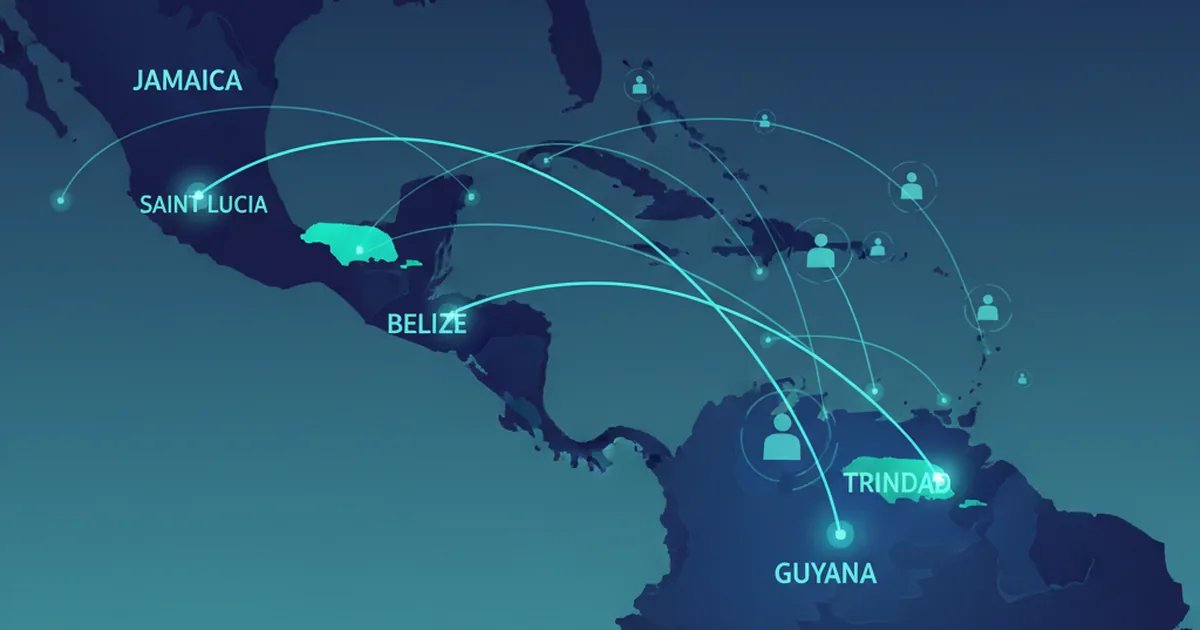
Quick answer. The Caribbean native-English BPO workforce sits roughly an order of magnitude smaller than the Philippines (low six figures of seats versus seven figures), which makes it the wrong answer for hyperscale volume and the right answer for niche regulated voice in US Eastern hours. Below is a country-by-country brief on Jamaica, Saint Lucia, Trinidad and Tobago, Belize, and Guyana: language status, time-zone fit, workforce sizing, and what the published attrition data does and does not support by geography. The fronter-only model keeps regulated handling with the client's US licensed closers.
Buyers shopping the nearshore voice market in 2026 keep landing on the same question. The Caribbean is closer, the English is better, the time zones line up, but how big is the labor pool really, and which countries actually carry it. This brief answers the sizing question per country, anchors each profile to public labor-statistics sources, and frames the trade-off against Philippines and India for procurement teams modeling regulated US outbound voice. The argument is not that the Caribbean is bigger than anywhere else. The argument is that the Caribbean is the right size for what regulated US voice procurement is actually buying.
Native English country profiles
Five Caribbean countries operate in English natively at the level of education, government, and commerce. Their BPO labor pools reflect that. The country profiles below pull from World Bank language and labor-force data and from each country's national statistical office.
Jamaica
Official language English. Time zone UTC-5 year-round (no daylight savings), which is full overlap with US Eastern Standard Time and one hour offset during US Eastern Daylight Time. Jamaica's BPO sector is the largest in the English-speaking Caribbean. The Jamaica Promotions Corporation (JAMPRO) and the Statistical Institute of Jamaica (STATIN) labor-force surveys support a workforce concentrated in Kingston, Montego Bay, and Portmore. The country has spent the last decade building outbound voice, customer support, and back-office capacity, and the labor pool reflects that history. No published attrition series exists for Jamaica or the wider Caribbean, so any Jamaica attrition figure, Call Force Global's included, is a vendor estimate rather than a published measurement. Operators generally report that anchoring wages to the local market rather than to labor-arbitrage minimums improves retention.
Saint Lucia
Official language English. Time zone UTC-4 year-round, which aligns with US Eastern Daylight Time. The Saint Lucia statistics department supports a labor force that is smaller than Jamaica's in absolute terms but has a high English-literacy rate and a tourism-trained service-orientation baseline. Smaller market size means BPO operators can hire selectively without the wage inflation that shows up in larger markets at capacity.
Trinidad and Tobago
Official language English. Time zone UTC-4 year-round (aligned with US Eastern Daylight Time, one hour offset during US Eastern Standard Time). The Central Statistical Office (CSO) labor-force data supports a BPO sector centered in Port of Spain. The labor market also benefits from a strong energy-sector base that has cycled qualified workers into adjacent service roles, including contact-center operations.
Belize
Official language English (the only Central American country with English as the official language). Time zone UTC-6 year-round, which is one hour offset from US Central Standard Time and two hours offset from US Eastern Standard Time. The Statistical Institute of Belize supports a workforce that is small in absolute terms but distinguished by English fluency at a Central American wage floor, which is a structural mix the rest of Central America cannot reproduce.
Guyana
Official language English. Time zone UTC-4 year-round. The Guyana Bureau of Statistics supports a labor force in transition as the country's energy sector reshapes wage expectations and labor mobility. The BPO sector is smaller and more recent than Jamaica or Trinidad, with sizing currently best treated as developing. The Guyana delivery page carries the current national labour force figures and states why no BPO employment total is quoted for the country.
Why English-first matters for regulated US voice
The case for native English in regulated outbound is not a matter of taste. It is about three measurable things.
- TCPA disclosure intelligibility. A disclosure that the consumer cannot parse is functionally absent. The Telephone Consumer Protection Act (47 USC 227) and the September 2024 FCC declaratory ruling on CG Docket No. 02-278 are clear that disclosures have to be communicated. Native-English delivery raises the floor on intelligibility versus delivery in English as a second language.
- CSAT impact. Contact-center research consistently links language clarity to perceived service quality. Our own read, offered as a Call Force Global observation rather than a published finding, is that buyers running consumer-facing US voice see lower CSAT volatility on native-English staffing.
- CMS and state clarity standards. The CMS Medicare Communications and Marketing Guidelines and parallel state insurance regulations carry clarity standards for any consumer-facing communication. Operating in the agent's first language is the lowest-cost way to meet those standards consistently.
None of these are theoretical. They are the three places regulated outbound voice fails an audit. English-first staffing reduces failure probability across all three.
Workforce sizing vs Philippines and India
Order of magnitude matters more than precision here. The Philippines IT-BPM workforce, per IBPAP industry data and World Bank labor statistics, sits in the seven-figure range, commonly modeled around 1.5 million. India's IT-BPM workforce is larger. The Caribbean BPO workforce, aggregated across Jamaica, Saint Lucia, Trinidad and Tobago, Belize, Guyana, Barbados, and the Dominican Republic (Spanish-first), sits roughly an order of magnitude smaller, in the low six figures, commonly modeled around 150,000.
That delta has two procurement implications. First, the Caribbean is not the right answer for hyperscale volume. A program needing 5,000 seats inside a quarter cannot stand it up in the Caribbean. Second, the Caribbean is structurally well-suited to niche regulated voice and same-time-zone fronter programs in the 10-to-200-seat band, which is the modal SMB outbound program. SLA flexibility on a 25-seat regulated-vertical program is better in a 150,000-person English-first market than in either a 1,500,000-person ESL market that has to compete for the slot or a 1,500-person market that has no slack.
Sizing rule of thumb. If your program is under 200 seats, regulated, and US Eastern, the Caribbean has the right size pool. If your program is over 1,000 seats or hyperscale-volume, the Caribbean is undersized for it.
How CFG selects and trains across the 6 delivery countries
CFG delivers from Jamaica, Saint Lucia, Trinidad and Tobago, Belize, Guyana, and Colombia. Toronto is HQ, and delivery is remote. The first five are native-English markets. Colombia is added to the footprint as a bilingual delivery option (Spanish-first with English-fluent agents trained for US voice), which extends reach for buyers running Spanish-language line-of-business in adjacent verticals.
Selection in each market follows three filters: English fluency at conversational-call level, full US Eastern overlap on the agent's normal sleep schedule, and a wage floor anchored to the local labor market. Training follows the 16-hour TCPA core curriculum on the offshore side, with regulated handling kept off the offshore agent and routed to the client's US licensed closers. Agents are fronters. The warm transfer is where the regulated work begins. We do not close licensed product. We do not quote rates. We do not bind. We pre-qualify and we hand off.
That scope split is what lets a Caribbean fronter program run cleanly in regulated verticals. It is also what lets the workforce-sizing math work: a niche regulated program in the 10-to-200-seat band is the right shape for the Caribbean pool. The broader category of nearshore outsourcing services covers how this fronter scope split maps to other Caribbean and LatAm delivery markets.
Get the next workforce update
When the World Bank, BLS, or Caribbean statistical offices publish new labor data that changes the country profiles, we send a brief. No pitch. Unsubscribe anytime.
Sources
- World Bank. Labor force participation and language data, Caribbean country pages.
- Statistical Institute of Jamaica (STATIN). Labor force survey.
- Central Statistical Office, Trinidad and Tobago. Labor force survey.
- Statistical Institute of Belize. Labor force survey.
- Saint Lucia statistics department. Labor force data.
- Guyana Bureau of Statistics. Labor force data.
- US Bureau of Labor Statistics. Contact-center occupational data.
- ContactBabel. US Contact Center Decision-Makers' Guide, 2024 edition, 189 US contact center managers. US attrition benchmark.
- CCAP Attrition and Retention Survey, conducted by Willis Towers Watson across 145 member organizations. Philippine contact center attrition.
- CARICOM Secretariat. Regional workforce and labor mobility reports.
Frequently Asked Questions
Which Caribbean countries have native-English BPO workforces?
Jamaica, Saint Lucia, Trinidad and Tobago, Belize, and Guyana all have English as the official or primary language of education and government, which produces a labor pool that operates in English natively rather than as a second language. World Bank language data and the respective national statistical offices (Jamaica STATIN, Trinidad CSO, Statistical Institute of Belize, Saint Lucia statistics department, Guyana Bureau of Statistics) support that classification.
How large is the Caribbean BPO workforce compared to the Philippines?
Order-of-magnitude, the Caribbean BPO workforce sits in the low six figures, commonly modeled around 150,000 across the region, while the Philippines IT-BPM workforce sits in the seven-figure range, commonly modeled around 1.5 million. The Caribbean is roughly one-tenth the size, which means it is not the right answer for hyperscale volume. It is well suited to niche regulated voice and same-time-zone fronter programs.
Why does native English matter for regulated US outbound voice?
Three reasons. First, TCPA disclosure language has to be intelligible to a US consumer or the disclosure is functionally absent. Second, CSAT studies consistently link language clarity to perceived service quality. Third, the CMS Medicare Communications and Marketing Guidelines and parallel state insurance regulations carry clarity standards that are easier to meet when the agent is operating in their first language.
What is the attrition norm in Caribbean BPO?
Published US contact center attrition runs a 31 percent mean and a 24 percent median (ContactBabel, US Contact Center Decision-Makers' Guide, 2024 edition, year-end 2023 data). Philippine contact center attrition was 43 percent on 2023 data reported by CCAP in May 2025 (CCAP Attrition and Retention Survey, conducted by Willis Towers Watson). No comparable published series exists for the Caribbean or Latin America, so treat any nearshore band, Call Force Global's included, as a vendor estimate rather than a published measurement.
Where does CFG deliver and how is regulated work handled?
CFG delivers remotely from six countries (Jamaica, Saint Lucia, Trinidad and Tobago, Belize, Guyana, Colombia) with HQ in Toronto. CFG agents are fronter-only and not licensed. They pre-qualify and warm-transfer the regulated portion of the interaction to the client's US licensed agents, who handle rate quotes, plan enrollment, binding adjustments, and any licensed-product sale.
Right-size your nearshore footprint
Native-English Caribbean, US Eastern overlap, fronter-only
CFG delivers from Jamaica, Saint Lucia, Trinidad, Belize, Guyana, and Colombia. Toronto HQ. English-first Caribbean agents and bilingual English-Spanish agents in Colombia, warm-transfer to your US licensed closers for regulated handling. The 60-second CFG calculator models the workforce-sourced cost against your current vendor. Pilot Month from one agent, no setup fee, no annual prepay, live seven business days after a completed kickoff.
Already modeled it? Book a 20-minute discovery call.