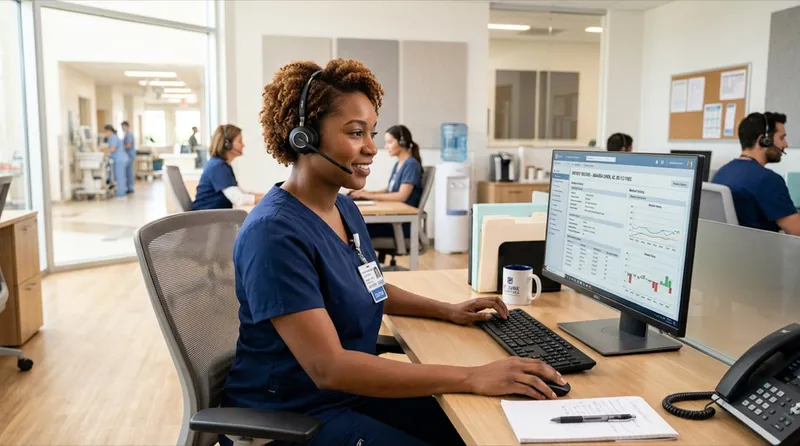
Quick Answer
Yes, you can outsource healthcare call center operations and remain HIPAA compliant. The critical requirement is a signed Business Associate Agreement (BAA) with your provider, combined with documented safeguards for protected health information. The rest of this guide covers exactly what those safeguards look like and how to evaluate whether a vendor actually has them in place.
Healthcare call center outsourcing works when the provider maintains genuine HIPAA compliance through a signed BAA, documented safeguards, and agents trained specifically in PHI handling. The rest of this guide breaks down exactly what that looks like in practice and how to verify it during vendor evaluation.
Healthcare is one of the last industries where outsourcing still makes people nervous. The reasons are understandable. Patient data is among the most heavily regulated information in the United States, and the penalties for mishandling it are severe. A single HIPAA violation can carry fines ranging from $100 to $50,000 per incident, and in cases of willful neglect, the Department of Health and Human Services has levied penalties exceeding $1 million. One unencrypted laptop, one untrained agent, or one misconfigured call recording system can cost more than an entire year of outsourcing fees.
But here is the reality that many healthcare administrators already know: most patient-facing phone interactions do not require a licensed clinician. Appointment scheduling, insurance verification, billing questions, prescription refill coordination, referral management. These tasks follow repeatable processes, and they consume enormous amounts of staff time at practices and health systems that are already stretched thin.
The question is not really whether healthcare call center outsourcing works. According to Deloitte's global outsourcing surveys, the healthcare BPO market is one of the fastest-growing segments in the industry, driven by staffing shortages and rising patient volumes. Everest Group research on healthcare outsourcing has similarly found that provider adoption of third-party patient communication services has accelerated in recent years. The real question is how to do it without putting your organization at risk.
Why Healthcare Outsourcing Is Different from Every Other Vertical
Healthcare call center outsourcing differs because of HIPAA requirements, PHI handling rules, and the need for agents trained in medical terminology.
If you have outsourced customer service for a retail brand or a SaaS product, you might assume healthcare works the same way. It does not. There are several layers of complexity that do not exist in other industries, and each one creates specific requirements for your outsourcing partner.
Protected Health Information Changes Everything
The moment a call center agent accesses a patient's name alongside any health-related information, that data becomes PHI under HIPAA. A single agent handling 80 patient calls a day creates 80 individual PHI touchpoints, each one a potential liability if safeguards are not in place. This is not limited to medical records. A patient calling to confirm an upcoming cardiology appointment has just created a data point that links their identity to a health condition. The agent who took that call is now handling PHI, and every system that call touches needs to be secured accordingly.
This has practical implications for how outsourced agents work. They cannot jot notes on paper. They cannot take screenshots. Their workstations need automatic screen locks and encrypted connections. Call recordings must be stored in HIPAA-compliant environments with appropriate access controls. None of this is optional.
The Business Associate Agreement Is Non-Negotiable
Under HIPAA, any vendor that creates, receives, maintains, or transmits PHI on behalf of a covered entity must sign a Business Associate Agreement before they touch a single patient record. The HHS guidance on business associates outlines these requirements in detail. The BAA is not a formality. It is a legally binding document that makes the vendor directly liable for HIPAA violations, subject to the same penalty structure that applies to the healthcare organization itself.
Key Point
If an outsourcing provider hesitates when you ask for a BAA, or tells you they do not need one because their agents "do not access medical records," that is a red flag. Any agent interaction that involves a patient's identity and their reason for calling creates PHI. Walk away from providers who do not understand this distinction.
Industry analysts note that the Business Associate Agreement has become the foundational document in healthcare outsourcing relationships, serving as both a legal safeguard and a practical framework for how PHI flows between organizations.
Patient Experience Has Clinical Consequences
In retail, a bad customer service interaction might cost you a Yelp review. In healthcare, it can cost you something more consequential. Patients who have negative experiences with scheduling or billing are less likely to follow through on appointments, refill prescriptions, or complete recommended follow-up care. Industry research consistently links patient communication quality to adherence and outcomes.
According to McKinsey's research on healthcare operations, organizations that invest in patient communication quality see measurable improvements in adherence rates and overall patient outcomes. This means the bar for agent quality in healthcare outsourcing is genuinely higher. Agents need empathy training that goes beyond scripts. They need to understand that the person calling about a billing dispute may also be dealing with a frightening diagnosis. The tone of that interaction matters in ways that are difficult to quantify but very real.
HIPAA Contact Center Outsourcing: Compliance Requirements for Healthcare
HIPAA compliance for outsourced call centers breaks down into three categories: administrative safeguards, physical safeguards, and technical safeguards. Any provider positioning itself as a HIPAA contact center outsourcing partner should be able to walk you through their approach to each one without reading from a brochure. Organizations evaluating vendors should also review their compliance credentials and work through a structured call center compliance checklist before signing any agreement.
Administrative Safeguards
These are the policies and procedures that govern how people handle PHI. For an outsourced call center, the critical ones include:
- Designated privacy and security officers who are responsible for HIPAA compliance within the organization, not just a line item on someone's job description
- Workforce training programs that cover the Privacy Rule, the Security Rule, the minimum necessary standard, and breach notification procedures, renewed at least annually with documented completion records
- Sanction policies for employees who violate HIPAA procedures, with clear consequences and documented enforcement
- Incident response plans that specify exactly how a potential breach is identified, contained, investigated, and reported within the 60-day notification window required by HIPAA
Physical Safeguards
For in-office call center operations, physical safeguards are relatively straightforward: locked facilities, badge access, visitor logs, workstation positioning that prevents screen visibility from common areas. For remote agents, this gets more complicated.
A healthcare call center that uses remote agents needs documented policies for home workspace requirements. This typically includes a private workspace with a door that closes, restrictions on shared computers, clean desk policies, and regular verification that these requirements are maintained. Some providers conduct virtual workspace audits; others require photo documentation.
Technical Safeguards
The technical requirements are where many outsourcing providers fall short, because genuine HIPAA-grade technical controls cost money to implement and maintain. At minimum, your provider should have:
- End-to-end encryption for all data in transit and at rest, including call recordings, chat transcripts, and CRM data
- Multi-factor authentication for every system that touches PHI
- Role-based access controls so agents can only see the minimum information necessary for their function
- Audit logging that tracks who accessed what patient information, when, and from where
- Automatic session timeouts that lock workstations after periods of inactivity
- Secure, HIPAA-compliant cloud infrastructure for any stored PHI, with BAAs in place with their own technology sub-vendors
That last point is important and often overlooked. If your outsourcing partner stores call recordings in AWS, they need a BAA with Amazon. If they use Salesforce Health Cloud as their CRM, they need a BAA with Salesforce. The chain of compliance extends to every system that PHI touches.
What Types of Healthcare Calls Can Be Outsourced?
Healthcare organizations outsource appointment scheduling, insurance verification, billing inquiries, prescription refills, and referral coordination.
Not every healthcare phone interaction is a candidate for outsourcing. The general rule is that any process-driven communication that follows established protocols can be outsourced effectively, while anything requiring clinical judgment should stay in-house with licensed staff.
Functions that outsource well include appointment scheduling and reminders, insurance eligibility verification, prior authorization follow-ups, prescription refill coordination, billing inquiries and payment processing, patient satisfaction outreach, referral management and coordination, and after-hours answering services that route urgent calls to on-call providers. If you are considering whether to keep these functions in-house or outsource them, our in-house vs. outsourced call center comparison breaks down the trade-offs. For outbound patient outreach campaigns such as appointment reminders or satisfaction surveys, providers must also maintain TCPA compliance for call center operations to avoid regulatory exposure.
Functions that typically remain in-house include clinical triage and medical advice, diagnostic discussions, treatment plan conversations, and any interaction where a clinical decision could change based on the patient's response.
The gray area is after-hours nurse triage, where some organizations use outsourced registered nurses to field calls using standardized clinical protocols. This can work, but it requires the outsourcing partner to employ licensed nurses in the relevant jurisdiction, which significantly limits the provider pool and increases costs.
Evaluating Healthcare Call Center Providers
When you are comparing providers for healthcare call center outsourcing, the evaluation criteria go well beyond what you would assess for a general customer service program (our guide to choosing a BPO partner covers the universal questions, but healthcare adds several more). Here is what to focus on.
Ask for Their HIPAA Compliance Documentation
Any provider claiming HIPAA readiness should be able to produce their most recent risk assessment, their written policies and procedures manual, their training curriculum and completion records, and evidence of their incident response plan. If they cannot produce these documents within a reasonable timeframe, they are likely building their compliance program on the fly rather than maintaining one as a matter of course.
Understand Their Agent Training Pipeline
Healthcare call center agents need training that goes beyond HIPAA basics. Ask specifically about how agents learn medical terminology for the specialties they will support, how empathy and de-escalation training works in a healthcare context, whether agents practice with simulated patient scenarios before going live, and what the ongoing quality assurance process looks like for healthcare-specific interactions.
A provider that treats healthcare accounts identically to their retail or telecom accounts is not investing in the specialization that healthcare requires. According to Gartner's research on BPO service delivery, providers with vertical-specific training programs consistently outperform generalists on compliance adherence and patient satisfaction metrics. For a deeper look at what numbers to hold your partner accountable to, see our guide to KPI benchmarks for outsourced call centers.
BPO leaders emphasize that the difference between a healthcare-ready operation and a general call center is not a matter of adding a HIPAA module to existing training, but building the entire operation around the requirements of handling protected health information from the ground up.
Examine Their Technology Stack
The provider's technology environment needs to support HIPAA compliance natively, not through workarounds bolted on after the fact. Look for HIPAA-eligible CRM and telephony platforms, integration capabilities with major electronic health record systems, call recording storage in HIPAA-compliant environments, and secure messaging platforms for any text-based patient communication. Many providers are also adopting AI-powered call center solutions to improve routing, quality monitoring, and compliance auditing, but any AI tools processing PHI must meet the same HIPAA safeguard requirements as the rest of the stack.
Check Their Business Continuity Plan
Healthcare operations do not get snow days. If your outsourcing partner's primary facility goes down, patients still need to reach someone. Ask about redundancy in their contact center infrastructure, geographic distribution of their agent workforce, failover procedures and how quickly they can activate them, and their track record with unplanned outages over the past 12 months.
Worth Noting
HIPAA does not prohibit outsourcing to providers outside the United States. A nearshore call center in the Caribbean, for example, can be fully HIPAA compliant if they maintain the required safeguards and sign a BAA. Understanding the differences between nearshore vs. offshore outsourcing models can help you evaluate which geographic approach best fits your compliance and operational needs. Jamaica-based call center operations and Trinidad and Tobago are popular nearshore choices for healthcare organizations because of the shared time zone, English fluency, and cultural alignment with US patients. If you are unfamiliar with what nearshore outsourcing is, it simply means working with a provider in a nearby country that shares your time zone and language. What matters is the substance of their compliance program, not their geographic coordinates.
Common Mistakes in Healthcare Call Center Outsourcing
The most common healthcare outsourcing mistakes are choosing generalist BPOs, treating HIPAA as a checkbox, and launching without a nesting period.
After working with healthcare organizations evaluating outsourcing options, certain patterns come up repeatedly. Avoiding these mistakes can save significant time, money, and regulatory exposure.
Assuming "HIPAA certified" means something. There is no official HIPAA certification program administered by HHS. Providers who claim to be "HIPAA certified" may have completed a third-party audit or self-assessment, which can be valuable, but the term itself carries no regulatory weight. Ask what the certification actually entailed and who conducted it.
Focusing on price over compliance infrastructure. The cheapest healthcare call center bid is often the most expensive one in the long run. Providers offering rates significantly below market may be cutting corners on security infrastructure, agent training, or compliance monitoring. The cost of a single HIPAA breach investigation dwarfs any call center outsourcing cost savings. HHS breach settlements routinely land between $500,000 and $5 million, which wipes out years of whatever you saved by choosing the cheapest provider. The same principle applies to insurance call center outsourcing, where compliance shortcuts create similar financial exposure.
Neglecting ongoing monitoring. Signing the BAA and completing initial training is not the end of the compliance obligation. Healthcare organizations retain responsibility for verifying that their business associates continue to meet HIPAA requirements. Build regular compliance reviews, call audits, and security assessments into your vendor management process. If you are growing your patient support operation, our guide on how to scale customer support covers operational best practices for expanding outsourced teams.
Treating all patient calls identically. Not every call requires the same level of PHI access. A well-designed outsourcing program segments calls by sensitivity and grants agents only the minimum necessary access for each function. Billing agents do not need to see clinical notes. Scheduling agents do not need to see payment history. Proper segmentation reduces risk surface area significantly.
Frequently Asked Questions
Can you outsource a healthcare call center and still be HIPAA compliant?
Yes. Healthcare organizations outsource call center operations routinely while maintaining HIPAA compliance. The essential requirement is a signed Business Associate Agreement with the outsourcing provider, combined with documented administrative, physical, and technical safeguards for protected health information. The provider becomes directly liable for HIPAA violations under the BAA.
What HIPAA training do outsourced call center agents need?
Outsourced agents handling PHI need training on the HIPAA Privacy Rule, the Security Rule, proper PHI handling and disclosure procedures, breach notification protocols, and the minimum necessary standard. Training must be documented and renewed annually. Agents should also receive scenario-based training specific to the types of patient interactions they will handle, covering medical terminology and empathy-driven communication.
What is a Business Associate Agreement in healthcare outsourcing?
A Business Associate Agreement is a legally required contract between a healthcare covered entity and any vendor that will access, store, or transmit protected health information. The BAA specifies how the vendor will safeguard PHI, report breaches, and comply with HIPAA requirements. Sharing PHI with an outsourcing provider without a signed BAA is itself a HIPAA violation, regardless of whether an actual data breach occurs.
Is nearshore healthcare call center outsourcing HIPAA compliant?
HIPAA does not restrict covered entities from working with vendors outside the United States, as long as a valid BAA is in place and the vendor maintains appropriate safeguards. Nearshore healthcare call centers in the Caribbean and Latin America can be fully HIPAA compliant if they implement the required technical controls, training programs, and data protection measures specified in the BAA.
What makes a call center HIPAA compliant?
A HIPAA compliant call center must have a signed Business Associate Agreement with the healthcare organization, implement administrative safeguards (workforce training, privacy officers, sanction policies), physical safeguards (secure facilities, workstation controls), and technical safeguards (encryption, multi-factor authentication, audit logging, role-based access). Agents must receive annual HIPAA training, and the center must maintain documented incident response and breach notification procedures. The compliance chain extends to every sub-vendor whose systems touch protected health information.
What types of healthcare calls can be outsourced?
Common outsourced functions include appointment scheduling, insurance verification, prescription refill requests, billing inquiries, patient satisfaction surveys, referral coordination, and after-hours answering services. Clinical decision-making must remain with licensed professionals, but the administrative and process-driven communication workflows surrounding patient care are well-suited to outsourcing.
Need a HIPAA-Ready Call Center Partner?
We will walk you through our compliance framework, agent training pipeline, and technical safeguards. Contact us for a confidential conversation about your healthcare outsourcing needs.