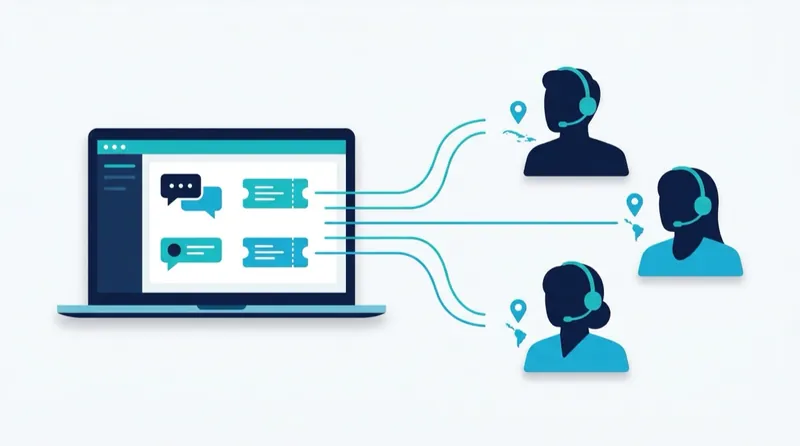
SaaS companies outsource customer support to reduce costs by 40 to 60% while maintaining technical quality across Tier 1 tickets, Tier 2 troubleshooting, and SDR functions. The key is choosing a nearshore BPO partner whose agents have technical backgrounds and integrate directly into your Zendesk, Jira, and Slack workflows. Series A through Series C companies in the 50 to 500 employee range get the most leverage from SaaS support outsourcing.
Your Zendesk queue is 400 tickets deep. Two of your engineers spent last week troubleshooting a customer's webhook integration instead of shipping the feature your board asked about. Your VP of CS just told you she needs three more hires, but your Series B runway says you need to extend to 18 months. Sound familiar? This is the exact moment most SaaS companies start Googling SaaS customer support outsourcing, and for good reason. Understanding how AI is transforming BPO is critical context here, because the technology is reshaping what outsourced teams can accomplish.
I run operations at a BPO that supports tech companies, so I will be upfront about my bias. But I also talk to founders every week who waited too long, burned out their internal teams, and ended up outsourcing in crisis mode instead of strategically. This piece is the guide I wish someone had handed me three years ago when we were figuring out how to build support operations that actually work for software companies.
Why SaaS Support Is Not Traditional Call Center Work
SaaS support requires agents who can debug APIs, distinguish bugs from feature requests, and ship updates biweekly, not follow static scripts.
Before we get into the how, we need to talk about why outsourcing SaaS customer service is different from outsourcing, say, an insurance claims line or a retail order status queue. Each vertical has its own demands - healthcare outsourcing requirements, for example, involve strict regulatory compliance that SaaS rarely faces - but tech support carries its own unique complexity.
Traditional call center work is largely transactional. A customer calls, the agent follows a script or decision tree, and the issue gets resolved or escalated. The knowledge base is relatively static. Product changes happen quarterly, maybe annually.
SaaS support is nothing like that. Your product ships updates every two weeks. Your customers are often technical themselves - developers, ops managers, data analysts - and they will know immediately if the person helping them does not understand the product. The questions are not "where is my order" but "why is your API returning a 403 when I pass this header" or "how do I configure your webhook to trigger on custom events."
On top of the technical complexity, SaaS support agents need to distinguish between a bug, a feature request, and user error. They need to know when to loop in engineering and when to solve it themselves. They need to document issues in a way that your product team can actually use to prioritize the roadmap. And they need to do all of this while making a frustrated customer feel heard - because in SaaS, a churned customer is not a $30 refund. It is $30,000 in annual recurring revenue walking out the door. With customer acquisition costs typically running 5 to 7 times the annual contract value, losing one enterprise account can wipe out the equivalent of $150,000 to $210,000 in sales and marketing spend.
This complexity is exactly why many SaaS founders assume support has to stay in-house. They look at the Philippines-based call centers that handle their cable company's support and think, "that could never work for us." They are right about the model. Wrong about the conclusion.
The right outsourcing partner for a SaaS company looks nothing like a traditional call center. The agents have technical backgrounds. The training is product-deep, not script-wide. The QA process measures resolution quality, not just handle time. And the team is embedded in your Slack, your Jira, your Zendesk - not operating from some disconnected island.
The Three Functions SaaS Companies Outsource
When tech companies explore SaaS technical support outsourcing, they usually start with one of three functions. Understanding which one matches your pain point matters, because the talent profile and ramp-up timeline are different for each.
Tier 1 Customer Support
This is the highest-volume, lowest-complexity layer. Password resets, billing questions, basic how-to guidance, feature walkthroughs, account configuration. In most SaaS companies, Tier 1 tickets represent 60 to 70% of total volume but require the least specialized knowledge. For a team handling 500 tickets a day, that means 300 to 350 tickets are candidates for outsourcing, freeing your senior staff to focus on the 150 complex issues that actually need their expertise.
Tier 1 is also where outsourcing delivers the fastest ROI. A well-trained external team can hit productive capacity within two to four weeks, and the metrics are straightforward to track. Industry benchmarks for outsourced Tier 1 SaaS support target CSAT scores of 85% or higher and first contact resolution rates between 70 and 75%.
The real benefit is not just cost. When you move Tier 1 off your internal team's plate, your senior support engineers and CS managers suddenly have capacity for the high-value work - onboarding enterprise accounts, building help center content, collaborating with product on UX improvements. That is the leverage most founders underestimate.
Technical Support (Tier 2)
This is where it gets interesting and where most generic BPOs fall short. Tier 2 SaaS support involves troubleshooting integrations, debugging API issues, investigating data discrepancies, and walking customers through complex configurations.
Outsourcing technical support requires agents with a fundamentally different skill set. You are looking for people who are comfortable reading API documentation, who understand how webhooks and OAuth flows work, who can navigate a browser's developer tools to diagnose a client-side issue. These agents exist in the nearshore talent pool - particularly in the Caribbean, where countries like Jamaica and Trinidad produce strong technical graduates - but you will not find them at a provider that primarily staffs retail call centers.
The ramp-up is longer for Tier 2. Plan on four to eight weeks of product-specific training before agents handle live technical tickets independently. But once that investment is made, a good outsourced Tier 2 team becomes an extension of your engineering support layer, and they free your actual engineers from the interrupt-driven work that kills deep focus.
SDR and BDR Functions
This one surprises people, but outbound sales development is one of the fastest-growing outsourcing categories for SaaS companies. The logic is simple: SDR work is high-volume, process-driven, and expensive to staff domestically. Industry data puts the cost of an outsourced SDR at $3,000 to $8,000 or more per month per rep, compared to a fully loaded domestic SDR who often runs $6,000 to $10,000 per month when you factor in base salary, benefits, tools, and management overhead.
Nearshore SDRs working US business hours can handle cold outreach, lead qualification, demo scheduling, and CRM hygiene. They operate inside your HubSpot or Salesforce instance, follow your sequences, and join your pipeline meetings. The savings are significant - industry research suggests nearshore saves 30 to 70% on SDR costs depending on the market and role complexity.
The catch is that SDR outsourcing only works when the partner genuinely understands your ICP and value proposition. An SDR who cannot articulate why your product matters to a VP of Engineering is worse than no SDR at all. This is not a function you hand off to the cheapest provider.
When Should a SaaS Company Outsource Support?
SaaS companies should outsource support between Series A and Series C, when ticket volume outpaces hiring and engineers are doing support work.
Timing matters more than most people realize. Outsource too early and you lose the customer insights that should be shaping your product. Outsource too late and you are making the transition under pressure, which leads to shortcuts.
After working with dozens of SaaS companies, I have seen a pattern in when the decision actually works well. It usually comes down to a few signals.
Your ticket volume is growing faster than your headcount. If your support team is chronically behind and every hire takes 8 to 12 weeks to recruit, onboard, and ramp, you are losing customers in the gap. An outsourcing partner with a bench of trained agents can compress that timeline dramatically.
Your engineers are doing support work. This is the most expensive form of customer service imaginable. Every hour an engineer spends answering a customer's configuration question is an hour they are not building product. At a fully loaded engineering cost of $75 to $150 per hour, each support ticket an engineer handles costs 5 to 10 times what it would cost an outsourced agent. If your engineering team regularly gets pulled into support, that is a sign your Tier 1 and Tier 2 coverage is insufficient.
You cannot staff nights, weekends, or holidays. SaaS customers expect fast responses regardless of time zone. If you are a US-based team providing support only during Eastern business hours, your West Coast afternoon tickets and your European morning tickets are sitting unanswered for hours. An outsourced team with shift coverage solves this without the pain of hiring for unpopular hours domestically.
You are between Series A and Series C. This is the sweet spot. You have enough product maturity and documentation to train an external team effectively, but you have not yet built such a large internal CS org that the transition becomes politically complicated. Companies in the 50 to 500 employee range tend to get the most leverage from outsourcing.
On the flip side, there are legitimate reasons to keep support in-house. The decision between in-house vs. outsourced support is not one-size-fits-all. If you are pre-product-market fit and still figuring out what your product should be, direct customer conversations are too valuable to delegate. If your product requires deep, ongoing engineering-level support for every single ticket - think infrastructure companies where every issue is essentially a debugging session - a fully outsourced model will struggle. And if your company culture treats support as a core competitive advantage and a talent pipeline into product roles, outsourcing that function changes the culture in ways you may not want.
What to Look for in a BPO Partner for SaaS
A SaaS BPO partner must integrate into your existing tools, staff agents with technical backgrounds, and measure resolution quality over handle time.
This is where most "how to outsource SaaS customer support" guides give you a generic checklist. I want to be more specific, because the difference between a good and bad outsourcing experience almost always comes down to a few concrete things.
Tool Integration, Not Tool Replacement
Your support stack - Zendesk, Intercom, Freshdesk, whatever you use - should not change because you outsource. The right partner operates inside your existing tools, uses your existing workflows, and shows up in your existing reporting. If a BPO wants you to migrate to their proprietary ticketing system, walk away. That creates a data silo that makes it nearly impossible to maintain visibility into support quality.
The same goes for communication. Your outsourced agents should be in your Slack (or Teams), in your standup cadence, and in your escalation channels. Siloed support - where the external team operates in a parallel universe and only communicates through a weekly report - is the single biggest reason SaaS companies have bad outsourcing experiences.
We have written a more detailed framework for evaluating BPO partners that covers contract terms, QA methodology, and reporting standards. But for SaaS specifically, tool integration is the deal-breaker.
Product Learning Speed
Ask any prospective partner how they handle product updates. If the answer involves "we will update the knowledge base quarterly," that is a traditional BPO answer that will not work for a SaaS company shipping biweekly. You need a partner whose agents can absorb a changelog, understand the customer impact, and adjust their troubleshooting within days - not months.
The best SaaS support partners assign a dedicated team lead who joins your product syncs, reviews release notes in real time, and cascades updates to the agent team before tickets start coming in. This is not a nice-to-have. It is the difference between agents who proactively know about a breaking change and agents who find out from an angry customer.
QA That Measures What Actually Matters
Traditional call center QA focuses on handle time, script adherence, and politeness. Those metrics are almost irrelevant for SaaS support. What you actually need to measure is resolution accuracy (did the agent solve the real problem, not just the surface symptom), escalation appropriateness (did they loop in engineering when needed, or did they waste engineering time on something they should have handled), and knowledge application (are they using the product documentation effectively, or are they guessing).
A strong QA process for SaaS support should include ticket audits scored against these criteria, regular calibration sessions between your internal CS leadership and the outsourced team, and feedback loops that connect QA findings back to training. If a provider cannot describe their QA methodology in this level of detail, they are probably running a checkbox process that will not catch the issues that matter to your customers.
The Nearshore Advantage for SaaS Companies
I have talked about nearshore outsourcing generally, but I want to make the case for why nearshore customer support for SaaS companies specifically makes more sense than offshore alternatives. The reasons go beyond cost.
Real-Time Collaboration Requires Timezone Overlap
SaaS support is not fire-and-forget. When an outsourced agent encounters a gnarly integration issue, they need to escalate to your engineering team in real time - not leave a note and wait 12 hours for a response. When your product team ships a hotfix, they need to tell the support team immediately, not wait for a timezone-appropriate handoff.
Caribbean-based teams operate in Eastern and Atlantic time zones. That means full overlap with US business hours, which means live Slack conversations, same-day escalation resolution, and the ability to pull an agent into a customer call with 10 minutes notice. Try doing that with a team 12 hours ahead in Manila.
For a deeper look at how nearshore call center outsourcing compares to offshore on these operational dimensions, we have a full breakdown.
Cultural Alignment With US SaaS Customers
This is one of those factors that sounds soft but has hard business impact. Caribbean agents grew up consuming the same media, following the same cultural references, and communicating in the same idiomatic English as your US customers. When a frustrated startup CTO sends a support ticket that says "this is driving me nuts, can someone just get on a call and walk me through it" - the agent reads the frustration accurately and responds with the right tone.
Cultural alignment also shows up in written communication. SaaS support is heavily text-based - live chat, email, Slack threads. The ability to write in natural, conversational American English without awkward phrasing or overly formal constructions matters more than most companies realize until they experience the alternative.
The Cost Math Works Out
Industry data shows that nearshore SaaS support typically costs about 50% less than equivalent domestic hires. That gap is not as dramatic as offshore savings, which can hit 60 to 70%. But when you factor in the hidden costs of offshore - higher attrition (industry data shows 30 to 40% annual turnover in Philippines call centers versus under 15% in Caribbean markets), timezone management overhead, quality rework, and the slower escalation cycles - the total cost of ownership often ends up comparable.
Meanwhile, the Latin American and Caribbean BPO market continues to grow rapidly, projected to reach $76.53 billion by 2027 according to Grand View Research. That growth is driven by exactly the kind of higher-complexity, tech-forward work that SaaS companies need. The talent pool is getting deeper, not shallower.
For the full cost picture across different outsourcing models and geographies, our call center outsourcing cost guide breaks down the numbers in detail.
How to Make the Transition Without Losing Quality
Knowing you should outsource and actually doing it well are two different things. The transition period is where most SaaS companies either set themselves up for long-term success or create a mess that takes months to untangle.
Start with Tier 1 and expand. Do not try to outsource your entire support operation at once. Move your highest-volume, most repeatable ticket categories first. Let the external team build confidence with straightforward work, then gradually shift more complex tickets as they demonstrate competency. Most successful SaaS outsourcing engagements follow a 90-day ramp where Tier 1 goes live in weeks one through four, lower-complexity Tier 2 in weeks five through eight, and full Tier 2 by week twelve.
Invest in documentation before you transition. The number one predictor of outsourcing success is the quality of your internal knowledge base. If your support team currently runs on tribal knowledge and Slack threads, an external team will struggle regardless of how talented they are. Spend two to four weeks documenting your top 50 ticket categories, common troubleshooting steps, and escalation criteria before agents start training.
Assign an internal champion. Someone on your team needs to own the outsourcing relationship. Not as a side project - as a real responsibility. This person runs weekly syncs, reviews QA reports, flags product changes that affect support, and serves as the bridge between your company and the external team. Without this role, outsourced teams drift.
Set metrics from day one. Agree on the KPIs that matter before the team goes live, and review them weekly for the first 90 days. Our guide to call center outsourcing KPIs covers the full list of benchmarks to track. For SaaS support, the metrics that actually indicate quality are CSAT (target 85% or higher), first contact resolution (target 70 to 75%), median resolution time (target under 24 hours for Tier 1, under 48 for Tier 2), and escalation rate (this should decrease over time as agents build product knowledge).
An Honest Assessment
Not every SaaS company should outsource support. If you have fewer than 100 tickets per week, the overhead of managing an external team probably is not worth it. If your product is so early-stage that the support experience is the product feedback loop, keeping it close makes sense. And if you have already built a world-class internal CS team that drives retention and expansion revenue, do not fix what is not broken.
But most SaaS companies I talk to are not in any of those categories. They are Series A or B companies with growing ticket queues, stretched internal teams, and a support experience that is slowly degrading as they scale. If that sounds like you, our guide on how to scale customer support through outsourcing lays out the operational playbook. They know they need help. They are just nervous about quality.
That nervousness is healthy. It means you care about your customers. But the data and the operational reality both point in the same direction: a well-chosen outsourcing partner, integrated into your tools and your workflows, operating in your timezone, will outperform the status quo of an overworked internal team that cannot keep up with ticket volume.
The companies that do this well treat outsourcing as an extension of their team, not a replacement for it. They keep product expertise and CS strategy in-house. They outsource the execution layer - the ticket volume, the coverage hours, the first-response speed. And they end up with better support metrics, happier internal teams, and more runway to invest in product.
The question is not really whether to outsource SaaS customer support. It is whether you want to do it proactively, while you have time to choose the right partner and manage the transition thoughtfully - or reactively, when your CSAT scores are already falling and your best CS people are already burned out.
I would strongly recommend the former.
Frequently Asked Questions
When should a SaaS company outsource customer support?
Most SaaS companies benefit from outsourcing when they hit 50 to 100 employees and support ticket volume starts pulling engineers or product managers away from core work. If your backlog is growing, CSAT is dropping, or you cannot staff weekend and evening coverage, those are strong signals it is time to explore SaaS customer support outsourcing.
How much does it cost to outsource SaaS customer support?
Nearshore SaaS support typically costs about 50% less than hiring domestically, with dedicated agents running $12 to $18 per hour in the Caribbean. SDR and BDR outsourcing runs $3,000 to $8,000 or more per month per rep depending on the complexity of the role and target market. For a complete pricing breakdown, see our call center outsourcing cost guide.
Can outsourced agents handle technical SaaS support?
Yes, but it requires the right partner. Look for BPO providers that recruit agents with technical backgrounds, invest in product-specific training, and integrate directly into your tools like Zendesk, Intercom, or HubSpot. The best outsourced technical support teams achieve first contact resolution rates of 70 to 75% on Tier 1 and Tier 2 issues.
What is the difference between nearshore and offshore SaaS support outsourcing?
Nearshore providers operate in the same or overlapping time zones as your US team, typically in the Caribbean or Latin America. This means real-time Slack communication, live escalation during business hours, and cultural alignment with US customers. Offshore providers in Asia offer lower hourly rates but introduce time zone gaps, potential accent barriers, and higher attrition rates. Our guide on what is nearshore outsourcing covers the full comparison.
Built for SaaS
See How We Support Tech Companies
We build dedicated support teams for SaaS companies - integrated into your tools, trained on your product, and operating in your timezone. Tell us what you need.