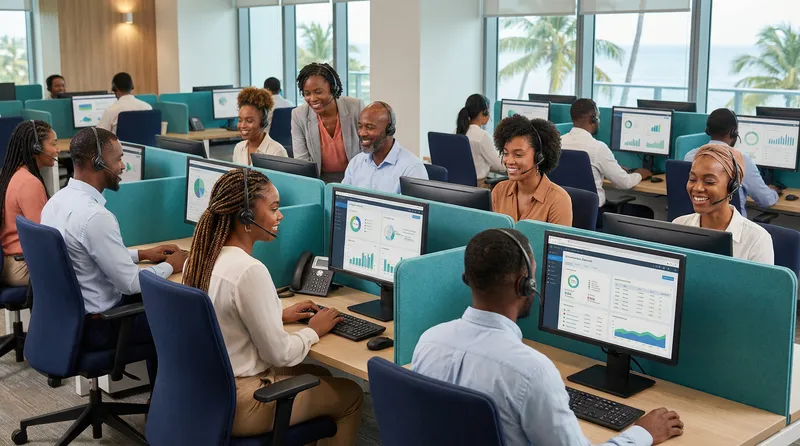
Customer support outsourcing to nearshore agents costs $10-16/hr with the same time zone, language, and cultural alignment as US-based teams. That is 40-60% less than domestic outsourcing, with none of the overnight-shift quality problems of offshore providers. SaaS companies, ecommerce brands, and tech companies scaling support get the strongest balance of cost, quality, and real-time collaboration by outsourcing customer support nearshore.
What Our Outsourced Customer Support Team Handles
CFG handles Tier 1 and Tier 2 customer support across phone, email, and live chat for US-based SaaS, ecommerce, and tech companies.
Call Force Global delivers multichannel customer support across phone, email, and live chat. Our nearshore agents handle the inbound volume that bogs down your core team: password resets, billing questions, product troubleshooting, and everything between.
Tier 1 Support
First-contact resolution for common inquiries. Account access, order status, billing, returns, refunds, and FAQ-level troubleshooting all fall under Tier 1. Agents work from your knowledge base and scripted workflows, resolving 70-80% of tickets without escalation.
Tier 2 Support
Escalated issues that demand deeper product knowledge, multi-step troubleshooting, or cross-team coordination. Tier 2 agents train on your product architecture, API behavior, and complex workflows. They investigate, document, and resolve what Tier 1 cannot, or prepare detailed escalation notes for your engineering team.
Multichannel Coverage
- Phone: Inbound call handling with average speed of answer under 30 seconds. Warm transfers to specialists when needed.
- Email: SLA-driven inbox management. First response within 1-4 hours depending on priority tier.
- Live chat: Real-time support with 2-3 concurrent conversations per agent. Integrates with Zendesk, Freshdesk, Intercom, HubSpot, or your custom helpdesk.
For your business: Most companies start by outsourcing Tier 1 phone and email to free their internal team for product development and complex escalations. Once the team proves out, adding chat and Tier 2 is a natural second phase. Our guide on scaling customer support with outsourcing walks through staging the transition.
Nearshore Customer Support Outsourcing vs. Offshore and Onshore
Nearshore agents in Jamaica, Trinidad, and Colombia work US time zones natively, speak fluent English, and cost 40-60% less than domestic teams.
Customer support suffers most from time zone and language gaps. A team 12 hours behind your customers means slow responses, lost context on handoffs, and mornings spent untangling overnight mistakes.
Real-Time Overlap
CFG agents in Jamaica, Trinidad, and Colombia work EST and CST business hours natively. A customer calls at 2 PM and your nearshore agent is mid-shift, fully alert. Your product team ships a hotfix at 4 PM and your support team relays the update to customers in real time. No overnight lag.
Native English, No Accent Concerns
Caribbean agents speak English as their first language. American customers find the accents natural and easy to follow on phone calls, which directly lifts CSAT scores. On written channels, emails and chat responses read cleanly without the grammar or phrasing issues common with non-native speakers.
Cost Comparison
| Support Model | Hourly Rate | Time Zone | Annual Cost (1 FTE) |
|---|---|---|---|
| In-house US agent | $22 - $35/hr loaded | Same | $46,000 - $73,000 |
| US outsourced | $22 - $40/hr | Same | $46,000 - $83,000 |
| Offshore (Philippines) | $7 - $12/hr | 12-13hr offset | $14,500 - $25,000 |
| Nearshore (CFG) | $10 - $16/hr | Same (EST/CST) | $20,800 - $33,300 |
Nearshore outsourcing cuts 40-60% off US rates while keeping the time zone alignment that offshore cannot match. For companies supporting US customers during business hours, real-time overlap alone justifies the modest premium over Philippines-based teams. Our full call center outsourcing cost breakdown covers detailed modeling by channel and tier.
Ready to see the numbers for your team?
Tell us your ticket volume and channels, and we will build a custom staffing plan in 24 hours.
Get Your Custom QuoteNo commitment required. Response within 24 hours.
Customer Support Outsourcing KPIs We Track
CFG tracks FCR, CSAT, AHT, ASA, escalation rate, and ticket backlog with daily dashboards shared directly with your team.
Every CFG support program is measured against industry-standard KPIs. These are the benchmarks your customers actually experience, not vanity numbers.
- First Contact Resolution (FCR): Issues resolved on the first interaction. Target: 75%+ for Tier 1, 85%+ combined. Industry benchmark sits at 70-75%.
- Customer Satisfaction (CSAT): Post-interaction survey scores. Target: 90%+. Measured via email or in-app survey after every resolved ticket.
- Average Handle Time (AHT): Total time from call or chat start to resolution, tracked per channel and issue type. We optimize for resolution quality first; speed targets are set during onboarding.
- Average Speed of Answer (ASA): Time from customer initiation to agent connection. Target: under 30 seconds for phone, under 60 seconds for chat.
- Escalation rate: Tickets escalated from Tier 1 to Tier 2 or to your internal team. Target: under 20% for mature programs.
- Ticket backlog: Open tickets at any point. We aim for zero backlog on standard SLA items by end of business day.
For a deeper look at what to measure and benchmark against, see our call center outsourcing KPIs and benchmarks guide.
How It Works
CFG onboards your nearshore customer support team in 3-4 weeks through a four-step process: scope, recruit, calibrate, and steady state.
Step 1: Scope and Design (Week 1)
We map your support workflow end to end: channels, ticket categories, escalation paths, tools, and SLAs. The output is a staffing plan with recommended team size, shift coverage, and ramp timeline.
Step 2: Recruit and Train (Weeks 2-3)
We recruit agents with relevant experience, then run product training using your knowledge base, past tickets, and call recordings. Training includes tool certification on Zendesk, Freshdesk, Intercom, HubSpot, or whichever helpdesk you use.
Step 3: Calibration (Weeks 3-4)
Agents handle live tickets under QA review. Every interaction is scored and daily feedback loops tighten scripts, macros, and escalation criteria based on real customer conversations.
Step 4: Steady State (Week 4+)
Your team operates independently. Weekly performance reviews, ongoing QA sampling, and regular knowledge base updates keep quality consistent. You receive daily dashboards and a weekly summary with KPI trends and recommendations.
Scaling timeline: Most clients go fully operational within 3-4 weeks. Adding agents to an existing program takes 1-2 weeks because the training curriculum and QA processes are already built.
Related Reading
Frequently Asked Questions
How much does customer support outsourcing cost?
What channels do your customer support agents handle?
What KPIs should you track when outsourcing customer support?
How do you onboard support agents on our product?
What Our Partners Say
"We went from 3-day ticket response times to same-day resolution after launching our nearshore support team. CSAT jumped from 72% to 89% in the first quarter."
VP of Customer Experience
SaaS Company, New York
Ready to get started?
Outsource Your Customer Support
Get a staffing plan and pricing proposal for your support team. Multichannel, same time zone, all-inclusive rates. Call 1-844-287-9234 or book a consultation at callforce.global/contact/.
No commitment required. Response within 24 hours.
Limited availability for Q2 2026 launches. Spots fill fast during peak season.