A critical-results communication checklist is an organization-approved workflow for getting a nonroutine diagnostic result from the interpreting team to an authorized recipient, recording acknowledgement, and escalating when acknowledgement is missing. The organization, not this template, defines which findings qualify, who may receive them, and the required timing.
This page covers the communication handoff only. It does not determine urgency, interpret images, recommend treatment, or prove that clinical follow-up occurred.
Print this checklist without entering an email address. The page contains no patient-data fields and stores no case data. Do not type, paste, or send patient information to Call Force Global from this resource.
Operational template only. This is not clinical guidance, legal advice, an accreditation standard, or a substitute for your organization's approved policy. Licensed clinical, privacy, security, and compliance owners must approve the findings in scope, authorized recipients, verification method, communication channels, timing, escalation, documentation, and retention before use. Relay personnel do not interpret findings or make clinical decisions.
This independent Call Force Global template is informed by the cited sources. It is not authored, approved, endorsed, or certified by the American College of Radiology, Joint Commission, or HHS.
Clinical-use approval gate: This independent operational template does not supply clinical policy. Before an organization adapts it for use, its licensed clinical owner must approve the findings in scope, recipient roles, verification method, communication interval, escalation, closure criteria, and clinical-question path.
Approval record: In the controlled document system, record the reviewer's name and credential, current-license verification source and date, exact sections reviewed, required changes, approval decision, approved version, effective date, and next review trigger. Publication of this template is not that approval.
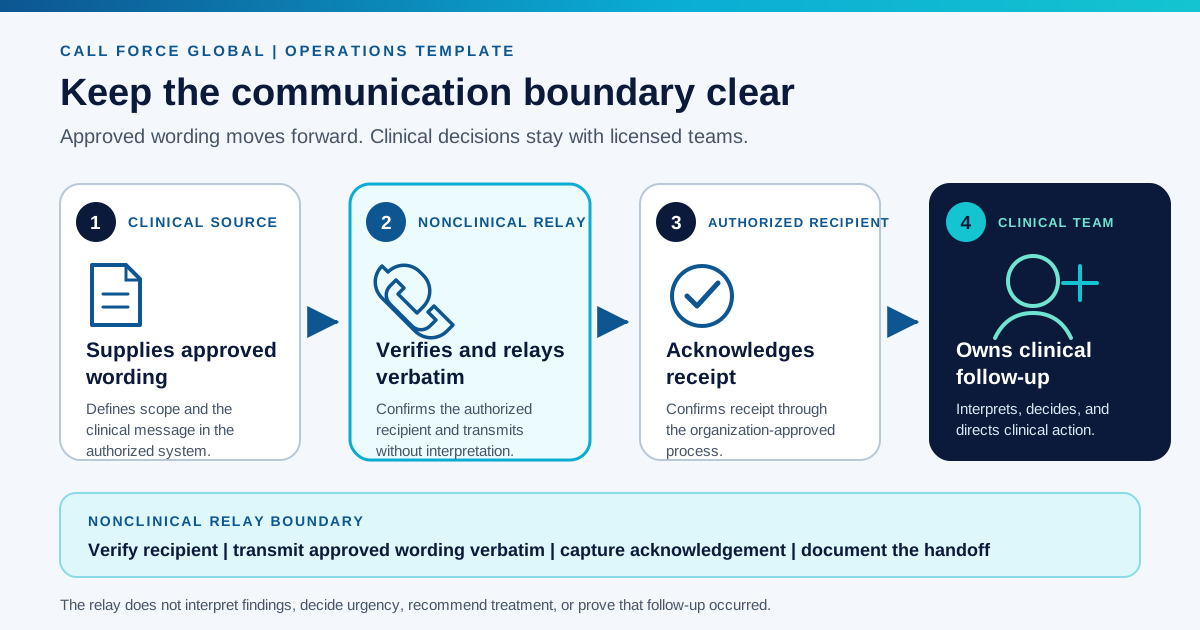
Download this boundary diagram (SVG)
What this checklist covers
This worksheet is for radiology groups, imaging operations leaders, hospital departments, privacy and security teams, and outside operations partners that are designing an overnight communication relay. It helps those owners turn an approved policy into a repeatable handoff. It is deliberately narrower than the full clinical process.
The relay begins when an approved source makes a finding available for nonroutine communication. It includes confirming that required source fields are present, locating the authorized recipient, applying the approved verification steps, stating the supplied wording, capturing acknowledgement, documenting attempts, and using the written backup path when acknowledgement is missing. It ends only under the organization's written closure criteria or when its designated owner accepts the handoff.
The relay does not classify a finding, decide urgency, select a recipient through judgment, interpret an image, answer a clinical question, recommend treatment, or certify follow-up. Those duties stay with licensed teams and the organization's accountable owners. Keeping that boundary explicit helps a buyer evaluate overnight after-hours answering and relay coverage without confusing communication support with clinical practice.
Principles behind a critical-results communication workflow
The official sources do not provide a universal outsourced call script. They support an organization-defined process. The current American College of Radiology practice parameter discusses expedited nonroutine communication, communication methods reasonably designed for receipt, documentation, and written policies that assign responsibilities. It also explains that the document is educational and is not an inflexible rule or legal standard of care.
The Joint Commission's current National Performance Goals place responsibility on the hospital to define critical results, reporting relationships, acceptable reporting intervals, documentation, and evaluation. Its handoff element also calls for a process that allows discussion between the giver and receiver. The Joint Commission's Quick Safety 52 discusses closed-loop communication as a safety concern and identifies vulnerable points such as missing acknowledgement, unavailable recipients, and weak backup paths. Quick Safety is informational, not an accreditation standard.
HHS guidance matters when an outside party creates, receives, maintains, or transmits protected health information on behalf of a covered entity. The exact legal relationship and any exceptions depend on the facts. A qualified privacy or legal owner should determine business-associate status and required contract terms. Where a Business Associate Agreement is required, it is only one control. The operating scope still needs approved access, safeguards, channels, incident reporting, subcontractor terms, and actual adherence.
Together, those sources support a practical design rule: the organization defines the clinical and legal decisions, while the relay workflow makes assigned communication steps visible, repeatable, and auditable. The following checklists preserve that division.
Before coverage starts: workflow setup checklist
Policy owner and scope
- A licensed clinical owner has approved the definition of critical results and the findings covered by this relay.
- The written policy names who initiates communication, who may receive it, and who owns clinical follow-up.
- The policy defines the acceptable reporting interval for each result category. This worksheet does not supply one.
- The overnight coverage window, time zone, start and end conditions, and handoff owner are documented.
- The script and contact matrix show a version number, effective date, review date, and change approver.
A versioned scope keeps operations from quietly drifting away from the approved policy. If a role, channel, system, or contact path changes, the accountable owner can evaluate and approve that change before it reaches the relay team.
Want this costed for your program?
Native-English nearshore agents at $14 to $18 per hour all-in for healthcare work, live 10 business days after kickoff. A senior ops manager replies within 24 hours with line-item pricing.
Roles and contact paths
- Primary and backup authorized recipient roles are named.
- The escalation owner and approved contact method are named.
- An owner and update cadence are assigned to the after-hours roster or directory.
- The process lets the receiving clinician reach an appropriate clinical source for questions. Relay personnel do not answer clinical questions.
- A downtime path exists for phone, approved clinical systems, authentication, and connectivity failures.
A contact list without ownership becomes stale. Record who maintains it, how an update becomes effective, and how relay personnel know they are viewing the current version. Test backup and downtime paths with synthetic records rather than discovering an access problem during a live handoff.
Privacy, systems, and vendor scope
- The privacy or legal team has determined whether each outside vendor is a business associate for this scope.
- Any required Business Associate Agreement is executed before the vendor creates, receives, maintains, or transmits protected health information.
- The written scope names approved systems, channels, data fields, actions, roles, retention, safeguards, and incident reporting.
- Subcontractors with access to protected health information are identified and subject to the applicable written restrictions.
- Access is limited to organization-approved fields and actions for the assigned relay role.
- No patient information is stored on personal devices, local files, public worksheets, or unapproved channels.
The applicable agreement should match the actual workflow. A broad contract does not replace system configuration or operating controls. The medical answering service scope guide provides related due-diligence questions for systems, permissions, and safeguards.
Script, documentation, and readiness testing
- The script identifies the caller, role, and purpose without adding clinical interpretation.
- The approved patient-verification and recipient-authorization steps are written into the script.
- The source of truth for the finding is named, and the script requires verbatim relay without paraphrase.
- The script includes the approved method for capturing and confirming the recipient's identity and acknowledgement.
- Voicemail, callback, backup, and escalation branches are written and approved; relay staff do not invent intervals.
- Required log fields and closure criteria are configured in the approved system.
- Primary, backup, downtime, mismatch, and suspected-incident scenarios have been rehearsed with synthetic data.
Readiness testing should demonstrate whether the script, roster, access, and documentation fit together. Use synthetic data and a controlled environment. Record defects, assign owners, and repeat the drill after corrections. The exercise verifies the designed handoff, not a medical decision or live-case result.
Per-case overnight relay checklist
Before contact
- Open the case only in the approved system.
- Confirm that the source record contains the fields required by the approved script. If information is missing or inconsistent, stop and escalate.
- Confirm the current authorized recipient and contact path from the approved roster.
- Complete the organization-approved patient-verification step before disclosing the finding.
The relay role checks for the presence and consistency of required source fields. It does not correct or infer a missing clinical detail. When a field does not match, the safe operational action is to pause and use the approved escalation path.
During contact
- Identify yourself, your role, and the purpose of the call using the approved script.
- Confirm that the person reached is authorized to receive the finding.
- State the finding exactly as supplied by the clinical source. Do not shorten, paraphrase, explain, or interpret it.
- Capture and confirm the recipient's identity using the approved method.
- Obtain and record explicit acknowledgement of receipt. Route clinical questions to the designated clinical source.
Verbatim relay protects the boundary between transmitting information and interpreting it. If the receiving person asks what a finding means or what should happen next, the relay personnel should connect or direct the question according to the approved path rather than improvise an answer.
After contact
- Record the date, time, time zone, method, contact attempted, recipient, outcome, acknowledgement status, and attempt number.
- If acknowledgement is missing, follow the written backup and escalation path. Do not invent a callback cadence or closure rule.
- Close the communication handoff only when the organization's written closure criteria are met or the designated escalation owner accepts responsibility.
- If there is a mismatch, misstatement, wrong-recipient contact, or suspected privacy/security incident, stop, preserve a factual record, and follow the approved incident path.
- Keep all live-case details in the authorized system. Do not enter them on this webpage or send them to Call Force Global through this resource.
Documentation should let an authorized reviewer reconstruct the communication steps without relying on memory. Record facts, not conclusions. An acknowledgement closes only the defined communication portion and should not be described as proof of later clinical action.
When acknowledgement is missing
Acknowledgement received from an authorized recipient?
- Yes: Record recipient, acknowledgement time, method, and outcome; close only under written policy.
- No: Record the attempt; use the approved backup recipient; if still unacknowledged, invoke the approved escalation owner.
Escalation owner accepts handoff? Record owner and acceptance time. If not, continue only as the written policy directs and notify the designated supervisor.
A delivery indicator or voicemail is not the same as recipient acknowledgement unless the organization's approved policy expressly defines it as satisfying the closure criterion.
This flow closes the communication handoff. It does not certify that clinical follow-up or treatment occurred. The organization decides how the communication record connects to the broader clinical workflow and who audits that connection.
Critical-results communication log template
Use these labels to design or test fields in an approved system. They are intentionally blank on this public page. Do not write live-case details on a printed copy or save them outside the authorized record.
Field labels are for workflow design and synthetic-data drills. Configure the live log inside an authorized system. Do not record patient names, identifiers, findings, or other protected information on this public webpage or send completed copies to Call Force Global.
Sample operating artifacts for buyer diligence
These are synthetic design examples, not client records. They show the evidence structure a buyer can require before approving a workflow. They do not establish that Call Force Global operates a live radiology relay, has achieved an outcome, or has received clinical approval. Replace every role, branch, field, and interval only through your organization's controlled approval process.
Sample escalation matrix
| Observed condition | Relay action | Assigned owner | Evidence required before closure |
|---|---|---|---|
| Primary recipient does not answer | Record the attempt and follow the approved backup branch. Do not invent an interval. | Organization-named backup recipient, then escalation owner | Explicit recipient acknowledgement or documented acceptance by the designated escalation owner |
| Recipient identity or authorization cannot be confirmed | Do not disclose the finding. Record the failed verification and escalate through the approved path. | Roster owner or designated supervisor | Successful verification with an authorized recipient, or accepted handoff under written policy |
| Required source field is missing or inconsistent | Pause the relay. Do not infer, correct, or paraphrase the clinical source. | Approved clinical source | Corrected source record or documented direction from the authorized clinical owner |
| Recipient asks a clinical question | State the nonclinical boundary and route the question to the approved clinical source. | Licensed clinical team | Communication handoff evidence only; no relay entry should claim a clinical answer or follow-up |
| Approved system or channel is unavailable | Use only the written downtime path and record the outage in the approved location when available. | Operations and system owner | Downtime handoff record, recovery status, and reconciliation into the approved system |
| Wrong-recipient contact or suspected privacy or security incident | Stop further disclosure, preserve factual evidence, and invoke the approved incident process. | Organization-designated privacy or security incident owner | Incident reference and owner acceptance; do not label the matter resolved unless that owner does so |
Synthetic acknowledgement log example
The sequence below uses a fictional case reference, placeholder finding text, and arbitrary drill times. It demonstrates factual logging, not a recommended callback cadence.
| Drill time | Synthetic event | Factual record |
|---|---|---|
| 01:12 ET | Source package available | Required fields shown as present in the test system. Relay role made no clinical determination. |
| 01:15 ET | Primary contact attempt | No answer. Attempt number, method, role contacted, and outcome recorded. |
| 01:19 ET | Approved backup reached | Recipient role and identity verified using the synthetic test script. |
| 01:20 ET | Verbatim relay | Placeholder text “[SYNTHETIC FINDING TEXT]” read exactly as stored. No explanation or advice added. |
| 01:21 ET | Explicit acknowledgement | Recipient confirmed receipt. Recipient identity, method, acknowledgement time, and record author captured. |
| 01:22 ET | Drill handoff closed | Synthetic communication criteria met. The entry makes no claim about clinical interpretation, follow-up, or treatment. |
Implementation sequence template
- Assign accountable owners. The organization names its licensed clinical policy owner plus privacy, security, legal, system, roster, and operations owners.
- Approve the boundary and data path. Define findings in scope, authorized recipients, source system, minimum fields, channels, retention, incident handling, and whether an outside party is a business associate.
- Build controlled artifacts. Version the script, contact matrix, verification steps, acknowledgement definition, closure criteria, downtime branch, and escalation matrix.
- Configure access and logging. Apply role-based access, required fields, audit events, recording settings where approved, and restrictions on unapproved local storage or channels.
- Run synthetic drills. Test primary, backup, failed-verification, missing-field, clinical-question, outage, wrong-recipient, and shift-handoff scenarios without patient information.
- Record approval or rejection. Required owners review drill evidence and the exact artifact versions. No live patient information enters the workflow before all required approvals are recorded.
- Use a controlled start if approved. Define monitoring, review sampling, incident stop conditions, issue owners, and change control. A later script or roster change returns through the applicable review gate.
Shift handoff checklist
- Review every open item in the approved system; do not copy patient details into this worksheet.
- Assign a named owner to each unresolved communication handoff.
- Confirm the last attempt, outcome, acknowledgement state, and next organization-defined step.
- Confirm that the current backup recipient and escalation owner are available.
- The outgoing and incoming owners discuss unresolved items and document acceptance of the handoff.
- Report roster, system, access, or connectivity problems through the approved operations path.
A change of shift should not create an ownership gap. The incoming owner needs enough status to continue the written process, while all protected information remains inside the approved system. A factual acceptance record makes responsibility visible without creating a second case file.
Quality review checklist
- The script and contact roster versions used were current.
- Required verification and recipient authorization steps were followed.
- The finding was relayed verbatim without clinical interpretation.
- Every attempt and outcome was documented in the approved system.
- Acknowledgement or accepted escalation handoff was documented before closure.
- Clinical questions were routed to licensed staff.
- Suspected incidents followed the approved reporting path.
- Timeliness was reviewed against the organization's own approved intervals, not a public benchmark.
- Sampling cadence, reviewer qualifications, and remediation owners are documented by the organization.
Quality review should compare the communication record with the policy and the versioned script. It should not create a public benchmark or imply that one interval fits every organization. Findings from the review should go to the accountable owners who can correct rosters, scripts, access, training, or system configuration.
Define review triggers in addition to the normal sampling cycle. A system change, roster failure, access problem, script revision, wrong-recipient contact, suspected incident, or repeated missing acknowledgement should prompt the appropriate owner to examine the affected workflow. The review record should identify the evidence considered, the decision owner, any corrective action, and the version that became effective. Use only approved records for this review and keep protected information out of public worksheets, meeting notes, and general-purpose collaboration tools.
Sample QA and reporting artifact
This blank layout makes the review basis and evidence visible. It contains no CFG performance figures and supplies no public pass threshold.
| Control reviewed | Evidence field | Result | Owner and corrective action |
|---|---|---|---|
| Current script and roster version used | Version IDs and effective dates | Pass / fail / not evaluated | ________________ |
| Required verification completed | Verification event and outcome | ___ of ___ reviewed records | ________________ |
| Source wording transmitted verbatim | Approved source-to-relay comparison | ___ of ___ reviewed records | ________________ |
| Explicit acknowledgement captured | Recipient, method, time, and acknowledgement event | ___ of ___ reviewed records | ________________ |
| Backup or escalation followed when required | Attempt sequence and owner acceptance | ___ of ___ applicable records | ________________ |
| Clinical questions stayed with licensed staff | Boundary statement and transfer event | ___ of ___ applicable records | ________________ |
| Incident path invoked when required | Incident reference and accountable owner | ___ of ___ applicable records | ________________ |
Required report footer: State limitations, unresolved exceptions, issue owners, due dates, verification method for corrective action, approving owner, and the exact version that becomes effective. An acknowledgement measure covers the communication handoff only and cannot be labeled as a clinical follow-up measure.
Human relay versus AI-only automation: control comparison
This is a workflow-design comparison, not a vendor ranking or performance test. A human relay is not a clinician, and a technology label does not prove a safe process. Either design needs organization-approved controls, evidence, exception handling, and clinical ownership.
| Control | Protocol-bound human relay | AI-only path | Evidence to inspect |
|---|---|---|---|
| Verbatim transmission | Reads locked source wording under a script. Human deviation remains possible and requires review. | Must be constrained to transmit stored source text without generating, summarizing, or interpreting it. | Versioned script or configuration plus source-to-delivery comparison from synthetic tests |
| Recipient verification | Follows the approved challenge and records the result. | Needs explicit identity and authorization logic with a fail-closed branch. | Passed and failed synthetic verification scenarios with event logs |
| Unexpected clinical question | States the boundary and routes the question to the approved clinical source. | Must not generate an answer; it needs an approved transfer, stop, or escalation branch. | Test transcript or recording, transfer event, and clinical-owner destination |
| Acknowledgement | Requests and records an explicit recipient response. | A delivery or connection event is insufficient unless the approved policy defines and captures recipient acknowledgement separately. | Recipient, method, time, acknowledgement event, and record author or system actor |
| Exception and outage | Uses the approved backup and downtime paths and can hand off to a named owner. | Needs dependency monitoring, a fail-closed state, and a named human takeover path. | Outage drill, escalation acceptance record, reconciliation step, and unresolved-item queue |
| Change control | Script, training, and roster changes require versioned approval. | Model, prompt, voice, integration, and policy changes require versioning, regression tests, and approval. | Change log, approver, test set, effective date, and rollback or stop condition |
The official sources cited below support an organization-defined communication process, documentation, acknowledgement, backup paths, and accountable owners. They do not establish a universal preference for a human or automated vendor design. The buyer should test the exact proposed workflow against its own policy and applicable requirements.
Clinical and privacy boundaries
A communication relay is an operational role. It transmits approved source wording, documents acknowledgement, and follows assigned branches. It does not decide whether a result qualifies, rank urgency, answer questions about meaning, recommend next steps, or replace a licensed professional. A clear script should say where the relay role stops and how a recipient reaches the appropriate clinical source.
Privacy controls should be evaluated against the actual data path. Map which system holds the source record, what fields the relay role can see, what channel is used, where an acknowledgement is recorded, who can audit the record, and what happens if information reaches the wrong person. The public checklist should never become a parallel case record.
Vendor due diligence should test the written scope, Business Associate Agreement where required, access controls, safeguards, subcontractor terms, incident path, roster ownership, and script governance together. Our medical answering-service comparison explains why a badge or marketing claim cannot replace this evidence.
Official sources and review notes
The following official sources were checked on August 11, 2026. This page paraphrases their operational implications and links readers to the originals. It does not reproduce their tables, graphics, or protected wording.
- American College of Radiology
ACR Practice Parameter for Communication of Diagnostic Imaging Findings. Revised 2025, Resolution 9; effective October 1, 2025. The ACR describes its practice parameters as educational and not inflexible rules or a legal standard of care. - Joint Commission
National Performance Goal 1: Right Patient, Right Care and the current Hospital National Performance Goals chapter, effective January 1, 2026. - Joint Commission
Quick Safety 52: Advancing safety with closed-loop communication of test results, issued December 2019 and still officially hosted. Quick Safety is informational and is not an accreditation standard or Sentinel Event Alert. - HHS
Business Associates guidance, last reviewed July 30, 2026, and sample Business Associate Agreement provisions. HHS says its sample is not required, may not satisfy state contract law, and is not legal advice.
Reuse note: ACR and Joint Commission materials are subject to their respective copyright and permission terms. Call Force Global has paraphrased and linked to them rather than reproducing tables, checklists, logos, seals, or extensive source language. HHS guidance is linked and attributed; HHS seals, logos, and stock images are not used. No source's appearance here implies endorsement.
Reference details
Cite this checklist
- Title
- Critical Results Communication Checklist for Radiology | CFG
- Publisher
- Call Force Global
- Published
- Content updated
- Canonical URL
- https://callforce.global/resources/overnight-critical-results-relay-checklist/
Call Force Global. (2026, August 11). Critical Results Communication Checklist for Radiology | CFG. https://callforce.global/resources/overnight-critical-results-relay-checklist/