60s
Emergency Dispatch
$13/hr
Dedicated Desk From
24/7
Coverage Available
7 business days
Live After Kickoff
Quick Answer
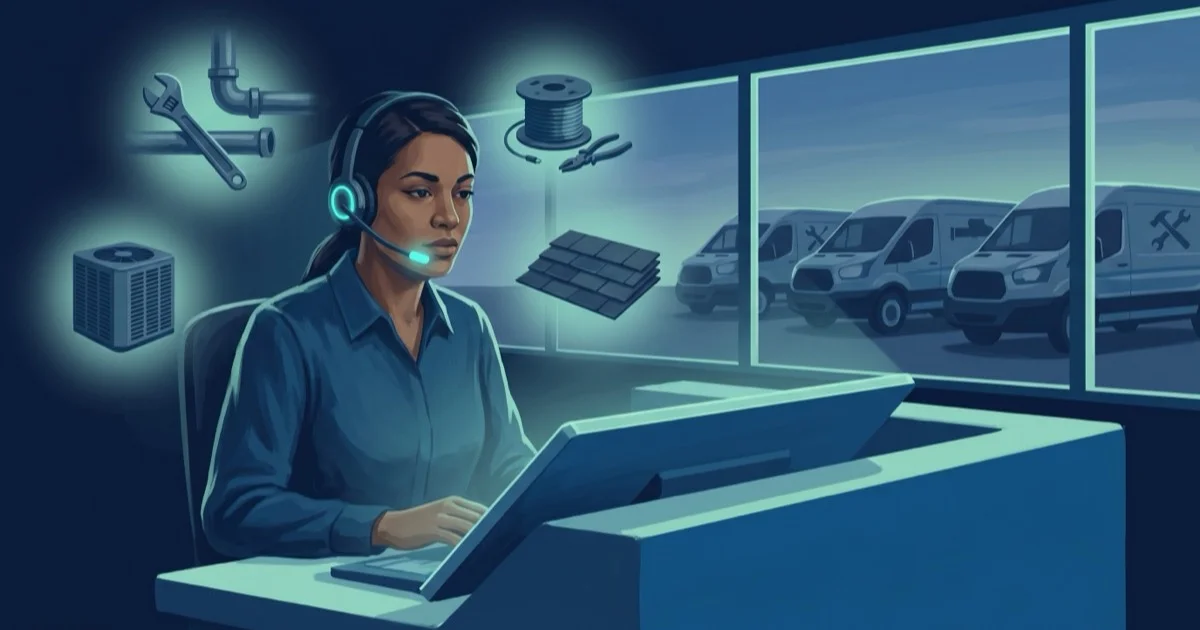
An after hours answering service for contractors is a live team that answers your trades business phone with a branded greeting, classifies the call as emergency or non-emergency using your written dispatch rules, and routes urgent calls to the on-call technician within 60 seconds. Standard emergency triggers cover the four largest trades: no heat below 40 degrees and gas smell for HVAC, active water leak and sewer backup for plumbing, burning smell at an outlet and total power loss for electrical, and active interior leak during rain for roofing. Call Force Global covers HVAC, plumbing, roofing, electrical, restoration, and other trades with a dedicated desk from two full-time agents at $13 an hour, with ServiceTitan, Housecall Pro, FieldEdge, Jobber, ServiceFusion, and Successware scheduling via secure web browser access. Native English nearshore agents on US time zones, live 7 business days after a completed kickoff.
What Is an After Hours Answering Service for Contractors?
An after hours answering service for contractors is a live team that answers a trades business phone with a branded greeting when the office is closed or busy, classifies the call as emergency or non-emergency using written dispatch rules, and routes urgent calls to the on-call technician within 60 seconds. For example, a no-heat call after 10pm in January gets routed via SMS or phone bridge to the on-call HVAC tech immediately. A 2am sewer-backup call routes to the on-call plumber via the same SMS bridge in the same 60-second window, with the agent walking the caller through emergency shutoff at the main if needed. A routine maintenance quote, by contrast, is logged into ServiceTitan or Housecall Pro for the front desk to call back the next business day. The caller hears your business name, never the answering service's. The same workflow runs across HVAC, plumbing, electrical, roofing, restoration, locksmiths, garage door, septic, pest control, and snow removal contractors, with the dispatch rules document adjusted per vertical.
Three workflows define the function for contractors:
- Branded after-hours greeting. Agents answer in your business name with your custom script. The caller hears your shop, never that the call left your office. Most contractors set their greeting around emergency triage on the first question ("What's happening?" rather than "How can I help you?").
- Emergency classification and dispatch. Agents follow a written dispatch rules document covering what counts as an emergency in your trade, who is on call by day of week, and how to reach them. Routing happens via phone bridge or SMS within 60 seconds of the agent confirming the emergency.
- Non-emergency message and booking. Routine calls (quotes, scheduled maintenance, billing questions) get logged with caller name, callback number, address, system or scope, and reason for the call. The agent either books directly into your scheduling software or sends the message to your front desk for the next business day.
What a contractor answering service does not do: diagnose problems over the phone, quote pricing, dispatch parts, run outbound sales calls, or operate your scheduling software autonomously without your written rules. For wider scope office work see virtual assistants or customer support.
Free 24-hour quote, no discovery call
Put a number on 24/7 contractor call coverage
Tell us your weekly call volume and the hours you need covered. A senior ops manager replies within 24 hours with a written quote for a dedicated desk from two full-time agents at $13 an hour. Live 7 business days after a completed kickoff.
Which Trades Does a Contractor Answering Service Cover?
A contractor answering service typically covers HVAC, plumbing, electrical, roofing, general contracting, restoration and water damage, locksmiths, garage door, septic, pest control, and landscaping or snow removal. Call Force Global runs the same agent pool across these verticals because the workflow is identical: branded greeting, emergency triage, dispatch routing, software scheduling, message logging, and after-hours escalation. The differences live in your written rules document and your trade vocabulary, not in agent training. An HVAC shop hands the agent rules built around no-heat-below-40-degrees and gas-smell triggers; a plumbing shop hands rules built around active water leaks and sewer backups; a restoration shop layers in mold or sewage exposure; an electrical shop centers on burning smell or sparks at outlets. The agent reads each shop's rules verbatim and routes accordingly. Most umbrella programs run on one dedicated desk of two or more full-time agents, sized to the shop's coverage hours.
Below is the umbrella view. Where a dedicated leaf page exists with deeper trade-specific dispatch rules and pricing detail, the trade name links through.
HVAC contractors
Heating, ventilation, air conditioning. Emergency triggers center on no heat in winter, no cooling during heat waves, gas smell, refrigerant smell, and electrical burning smell at the unit. Peak seasons: first cold snap of fall and the first heat wave of summer. Dispatch software typically ServiceTitan, Housecall Pro, FieldEdge, or ServiceFusion. See the HVAC answering service cost guide for full HVAC dispatch rules and desk cost math.
Plumbing contractors
Residential and light-commercial plumbing. Emergency triggers center on active water leak, sewer backup, no water at the main, no hot water in winter, gas smell at a water heater, burst pipe, and sump pump failure. Peak seasons: first freeze week of winter and the spring thaw. Dispatch software typically ServiceTitan, Housecall Pro, FieldEdge, or Jobber. See answering service for plumbers for full plumbing dispatch rules and desk cost math.
Electrical contractors
Residential and commercial electrical. Emergency triggers center on burning smell at outlets or panels, sparks, total power loss in a portion of a structure, exposed wiring after storm damage, and any condition with smoke. Peak seasons: storm season in the Southeast and Gulf, winter ice storms in the Northeast and Midwest. Dispatch software typically Housecall Pro, Jobber, or ServiceTitan. Same desk rates as HVAC and plumbing.
Roofing companies
Residential and commercial roofing. Emergency triggers center on active interior leak during rain, storm damage with water entry, fallen tree or branch impact, and missing sections of roof after high winds. Peak seasons: hurricane season for the Gulf and Southeast, storm season for the Midwest and Northeast. Dispatch software typically Jobber, ServiceFusion, or Housecall Pro. Branded greeting and overflow capture during peak storm weeks is the most common use case.
General contractors
Remodel, renovation, build-out, and home addition shops. Most calls are non-emergency project inquiries that need lead capture and follow-up scheduling, not dispatch. Where the GC also handles emergency restoration work, dispatch rules borrow from the plumbing and roofing playbooks (water leak, fire damage, structural emergency). Dispatch software typically Buildertrend, Jobber, or CoConstruct, accessed via secure web browser.
Restoration and water damage
Mitigation, drying, mold, and fire damage restoration. Nearly every inbound call is urgent because callers are looking at active damage. Dispatch is fast triage to a mitigation crew. Insurance carrier referrals add a structured intake step (claim number, carrier, policyholder details). Dispatch software typically Encircle, DASH, or Restoration Manager via secure web browser. Round-the-clock coverage is the most common pick because the trade itself is 24/7.
Locksmiths
Lockouts, lock changes, automotive lockouts, commercial rekeys. Emergency triggers center on active lockouts (residential, automotive with a child or pet inside, commercial after-hours), break-in damage, and safe access. The trade is heavily 24/7 and after-hours. Dispatch software typically Housecall Pro or Jobber. Night and weekend coverage is the most common pick; a dedicated desk fits locksmith groups running several vans with steady call volume.
Garage door
Garage door repair, install, and opener replacement. Emergency triggers center on a door stuck in the open position (security risk), a door stuck closed with a vehicle inside, broken springs, and motor failures during severe weather. Peak seasons: winter cold snaps for spring breakage, summer heat for opener failures. Dispatch software typically Housecall Pro, Jobber, or ServiceTitan.
Septic services
Septic pumping, repair, and emergency overflow. Emergency triggers center on tank backup into a home, drain field surfacing, and pump alarms during a storm. Peak seasons: spring thaw and heavy-rain weeks. Dispatch software typically ServiceFusion, Jobber, or in-house systems via secure web browser. Often paired with a plumbing contractor in rural and suburban markets.
Pest control
Residential and commercial pest. Emergency triggers center on stinging insect activity (wasps, bees, hornets near entrances), wildlife inside a home (raccoons, bats, snakes), bed bug emergencies in commercial lodging, and rodent infestations. Peak seasons: spring and summer for stinging insects, fall for rodents seeking shelter. Dispatch software typically PestRoutes, FieldRoutes, or Jobber.
Landscaping and snow removal
Landscaping has light dispatch needs (most calls are quote inquiries), but snow removal is heavily emergency-driven. Snow removal triggers center on missed plow window during an active storm, ice on commercial property with liability exposure, and stuck equipment. Peak seasons: winter storms for snow removal, spring and summer for landscaping inquiries. Dispatch software typically Jobber, LMN, or Service Autopilot.
Other trades
The same workflow extends to handyman shops, painting contractors, fence and deck builders, junk removal, gutter cleaning, chimney sweeps, pool service, pressure washing, and similar growing trades. Pricing follows the same desk rates since the underlying labor model and dispatch workflow are the same.
Trade-Mix Patterns We See on Contractor Accounts
Three contractor profiles drive most umbrella answering-service accounts: the multi-trade residential shop, the disaster restoration responder, and the property-management-adjacent recurring-services contractor. Each has a different ratio of emergency to routine calls, a different software mix, and a different on-call rotation. Recognizing which profile fits decides whether umbrella is the right starting point or whether to jump to a single-trade leaf page.
Profile 1: The "we do everything" residential shop
Two to ten trucks, owner-operated, covering a single county or metro. Core trades are HVAC plus plumbing, with electrical or handyman work bolted on by a generalist tech. The dispatch challenge is that one agent has to recognize emergency triggers across three or four trades, which is why the rules document is the single most important part of account setup. Software is usually Housecall Pro or Jobber. Coverage need is after-hours plus weekends, occasionally lunch rush.
Profile 2: The disaster restoration responder
Restoration shops live downstream of plumbing, roofing, and fire emergencies. They need agents who can take a call about an active sewage backup, flood, smoke event, or storm damage and get a responder rolling within minutes. Software is often ServiceFusion or a custom CRM. Coverage need is full 24/7 with a documented escalation path to a senior on-call manager when the lead tech does not pick up. These accounts almost always run round-the-clock coverage at the $15 to $19 out-of-hours rate.
Profile 3: The property-management-adjacent contractor
Recurring trades work tied to apartment buildings, HOAs, or commercial property managers. The agent's job is more about clean ticket creation in ServiceTitan or FieldEdge with the correct property code and unit number than emergency triage. Coverage need is often weekday business hours overflow plus evening. A two-agent desk on business hours plus evenings fits most of these.
What Does an Answering Service Cover for Contractors?
An answering service for contractors covers branded greeting, emergency classification, dispatch routing, non-emergency message taking, appointment scheduling into ServiceTitan or Housecall Pro, lead qualification for new-customer calls, after-hours overflow, holiday and weekend coverage, and bilingual Spanish-English seats on request. The function set is narrower than a virtual receptionist and broader than voicemail: agents do not run outbound sales, diagnose plumbing or HVAC problems over the phone, quote pricing, or operate dispatch software autonomously without your written rules. Agents do answer with your branded greeting, capture caller name and address and equipment type, classify as emergency or routine using the trade-specific rules document you provide, and either dispatch to the on-call technician via SMS or phone bridge or log the call into your scheduling software. The same function set applies across HVAC, plumbing, electrical, roofing, restoration, and other trades; only the dispatch rules document and trade vocabulary change per vertical.
- Branded greeting. Agents answer with your custom script. Caller hears your business name. Greeting opens with the emergency-triage question.
- Message taking. Caller name, callback number, service address, system or scope (HVAC unit type, plumbing system, electrical panel age, roof type, etc.), and the specific issue. Sent to you by email, SMS, or both, in real time or end-of-shift.
- Urgent dispatch. You give us a rules document. Agents follow it. Trade-specific emergencies (no heat, water leak, sparks, active roof leak, sewer backup, gas smell) get routed to the on-call technician via phone bridge or SMS within 60 seconds.
- Appointment scheduling. Agents book directly into ServiceTitan, Housecall Pro, FieldEdge, Jobber, ServiceFusion, or Successware via secure web browser access to your existing software account.
- Lead qualification. A short script that confirms the call is real intent, not a wrong number. Includes capturing the type of job (repair, install, maintenance) and rough scope.
- After-hours overflow. Coverage for 5pm to 8am weekdays plus full weekend. The most common coverage we set up for trades shops.
- Holiday and vacation coverage. Burst capacity for Thanksgiving, Christmas, New Year's, July 4, Memorial Day. Set up once, runs every year.
- Bilingual on request. Bilingual Spanish-English agents bill at the same rate as English-only agents on every desk. Most often used by contractors in Texas, Florida, California, Arizona, and the Northeast.
What Counts as an Emergency by Trade?
Emergency triggers vary by trade but follow the same logic: an active condition with property damage, safety risk, or comfort failure during weather extremes. Each contractor writes a one-to-two-page dispatch rules document that the agent follows on every call. An HVAC shop in Minnesota typically sets "no heat below 40 degrees Fahrenheit" as the first emergency trigger; a plumbing shop in Florida typically sets "active water leak with visible ceiling damage" as the first; a restoration shop usually sets "any of the above plus active mold or sewage exposure"; an electrical shop sets "burning smell or sparks at any outlet". The agent reads the trigger wording verbatim from the rules document on every call, removing the judgment call from the agent and keeping it with the contractor where it belongs. Below are the standard-of-care triggers used in dispatch rules across the four largest trades. Adapt to your shop's service area, equipment mix, and on-call rotation.
HVAC emergency triggers
No heat below 40 degrees
Furnace or heat pump failure during cold weather. Caller cannot heat the home. Dispatch runs at emergency priority during heating season because pipe-freeze risk compounds with each hour. Most common emergency call from late October through March across the Sunbelt and the entire Northern half of the US.
No cooling during heat waves
AC failure during sustained high temperatures, especially with elderly or medical-equipment-dependent occupants. Dispatch is urgent in heat waves above 95 degrees because of heat illness risk. Standard priority outside heat waves.
Gas smell at the HVAC unit
Caller reports a gas odor near a gas-fired furnace or water heater that shares HVAC mechanical space. Agent advises caller to leave the home and contact the gas utility (911 if severe), then dispatches a tech as backup. Highest safety priority.
Refrigerant smell or electrical burning smell at the unit
Refrigerant leak (sweet chemical smell) or electrical burning smell at the indoor or outdoor unit. Agent instructs caller to shut the system off at the thermostat or breaker, then dispatches. Urgent because both conditions can escalate.
Plumbing emergency triggers
Active water leak
Continuous drip or active stream from a fixture, supply line, or pipe. Caller often reports water damage in progress (drywall, ceiling, hardwood floor). Highest dispatch priority alongside burst pipes and gas smell at a water heater.
Sewer backup or burst pipe
Sewage backing into a tub, shower, floor drain, or yard, or a burst pipe with running water in the basement, crawlspace, or behind a wall. Both trigger immediate dispatch. Burst pipes peak the first freeze week of winter and the spring thaw.
No water at the main or no hot water in winter
Whole-house no water (frozen, leak, municipal shutoff, well pump failure) or water heater failure during below-freezing weeks. The home becomes uninhabitable until restored. Dispatch is urgent during cold weather and standard priority otherwise.
Electrical emergency triggers
Burning smell or sparks at an outlet or panel
Caller reports smell of burning plastic at an outlet, switch, or service panel, or visible sparks. Agent instructs caller to shut off the breaker if it can be reached safely, then dispatches at highest priority. Fire risk.
Total power loss in a portion of a structure
Whole-house or zone power loss not attributable to a known utility outage. Triggers main panel investigation. Dispatch is urgent when life-safety equipment (sump pump, medical equipment, refrigerated medication) is in the affected zone.
Exposed wiring after storm damage
Storm has pulled the service drop, knocked over a meter, or exposed wiring inside a structure. Agent advises caller to keep distance, contact the utility for a service drop issue, and dispatches an electrician for the structure side.
Roofing emergency triggers
Active interior leak during rain
Water visibly entering the structure during an active rain event. Caller often reports staining, dripping, or a bowed ceiling. Dispatch runs at emergency priority because each hour adds to the eventual restoration claim.
Storm damage with water entry
Hail, high wind, or hurricane damage that has compromised the roof envelope and is allowing water in. Common during hurricane season for the Gulf and Southeast and the spring storm season for the Midwest.
Fallen tree or branch impact
A tree or major branch has struck the roof. The roof envelope is compromised and the structure may have water entry or structural damage. Dispatch is urgent for tarping and damage assessment.
Restoration and water damage shops typically inherit any of the above as their inbound emergency call, since restoration is the downstream service after a plumbing, roofing, or fire emergency. Non-emergency calls across all trades (slow-developing issues, routine quotes, scheduled maintenance, billing questions) are logged for next-business-day follow-up.
Does the Answering Service Integrate With ServiceTitan, Housecall Pro, or Jobber?
Call Force Global agents book directly into ServiceTitan, Housecall Pro, FieldEdge, Jobber, ServiceFusion, and Successware via secure web browser access to your existing software account. The agent captures the call details on your branded greeting, opens the booking workflow in your software, creates the job ticket with the correct service type, priority, and dispatch zone, then attaches the call notes for the morning dispatcher to review. Most contractors use this for new appointment booking during overflow hours and for routine non-emergency calls that arrive after hours. True emergencies (active water leak, no heat in winter, gas smell, electrical burning smell) are handled separately via SMS or phone bridge to the on-call technician within 60 seconds of emergency confirmation, since dispatch software workflows are too slow for active emergencies. Software integration setup is included at no additional fee.
Supported trades software
- ServiceTitan. The largest dispatch and CRM platform for residential trades. Agents create jobs, assign service types, and apply dispatch zones across HVAC, plumbing, and electrical.
- Housecall Pro. Common with 1 to 10 truck shops across nearly every trade. Agents schedule jobs, attach customer notes, and trigger SMS confirmations.
- FieldEdge. Used by larger residential and light-commercial HVAC and plumbing shops. Agents create work orders and update customer records.
- Jobber. Common with smaller residential operations across HVAC, plumbing, electrical, lawn care, and snow removal. Agents schedule jobs and capture customer details.
- ServiceFusion. Mid-market trades software for HVAC, plumbing, septic, and roofing. Agents handle job creation and dispatcher routing.
- Successware. Used by larger commercial-leaning HVAC and plumbing operations. Agents create service requests and route to the appropriate technician.
Software integration setup is included at no additional fee at Call Force Global. One-time setup fees at US-based providers are typically quoted in the $150 to $500 range, though this varies by provider; we don't charge for it, since most trades shops already have web browser access available for their staff. Real product names listed above reflect the most common scheduling platforms used by US contractors and are not partnership claims.
How Much Does a Contractor Answering Service Cost in 2026?
Call Force Global prices contractor answering as a dedicated desk that starts at two full-time agents (40 hours a week each): $13 an hour on the Staffed Desk, $14 on the Scored Desk and $15 on the Open Desk in business hours, and $15 to $19 an hour for nights, weekends and 24/7. Per-call answering services typically charge $1.50 to $3 per answered call. Two agents on the $13 Staffed Desk at 160 hours each come to $4,160 a month ($1,040 a week), which suits multi-truck shops covering lunch-rush overflow and evenings. Full nights and weekends (118 hours a week) with one agent on the line at all times run about $7,670 to $9,715 a month, and true 24/7 (168 hours a week) about $10,920 to $13,832, which is where restoration and multi-county operators usually land. The Pilot Month bills at the desk's normal hourly rate, then month to month on 30 days' notice; a 6-month term takes $0.50 an hour off and a 12-month term $1.00, with no setup fee and no annual prepay. A dedicated desk suits businesses with steady daily volume, roughly 300 or more calls or interactions a month. Below that, a per-call answering service is usually the better buy, and we will say so on the scoping call. US-based providers typically run $400 to $2,500 per month or $3 to $7 per answered call.
| Desk | Rate | Monthly Example | Coverage | Best Fit |
|---|---|---|---|---|
| Staffed Desk | $13/hr | $4,160 for 2 agents x 160 h | Business hours, lunch rush and evenings on your phone system and dispatch software | Multi-truck shop with steady daytime overflow and lunch rush |
| Scored Desk | $14/hr | $4,480 for 2 agents x 160 h | Our phone system and local caller IDs, call recording and 100% AI QA on calls | Shop that wants us to carry the line, caller ID and QA |
| Open Desk | $15/hr | $4,800 for 2 agents x 160 h | The full desk, including the live client portal | Multi-location operator that wants live reporting |
| Nights, weekends, 24/7 | $15 to $19/hr | About $7,670 to $9,715 for full nights and weekends; about $10,920 to $13,832 for 24/7 | One agent on the line at all times through the hours you choose | Restoration responders and multi-county emergency trades |
Monthly examples are arithmetic on Call Force Global's published 2026 rates, not quotes. Full nights and weekends are weeknights 6 PM to 8 AM plus all weekend, 118 hours a week (about 511 a month); 24/7 is 168 hours a week (about 728 a month).
For the full cost calculator and the in-house CSR comparison, with bilingual Spanish-English agents at the same rate as English-only, see the trades cost calculator, or read the dedicated in-house CSR vs answering service cost guide. The same desk rates apply to every trade since the underlying labor model is the same. Compared to the cost of an in-house customer service representative (roughly $63,000 to $76,000 per year fully loaded, based on the U.S. Bureau of Labor Statistics, Occupational Employment Statistics, May 2025 median wage of $44,770 for SOC 43-4051 plus payroll taxes, benefits, equipment, training, and supervision), two dedicated agents on the $13 Staffed Desk come to about $49,920 a year at 160 hours each a month, for twice the hours one in-house CSR covers.
How Cross-Trade Dispatch Economics Work
An umbrella program that dispatches for HVAC, plumbing, and electrical from the same agent pool runs at a lower per-call cost than three separate single-trade programs because training, QA, software access, and idle-time blending consolidate. Operationally we treat this as one account with three rules documents. The same agent reads the same call structure across trades and only branches at the emergency-trigger step.
Savings stack in a few specific places. Training: one branded greeting, one CRM workflow, and one ticket-handoff protocol cover all three trades. QA: one weekly review pass evaluates the agent across the full trade mix instead of three siloed reviews. Software access: one ServiceTitan or Housecall Pro account handles all three trade ticket types. Idle-time blending: the morning lull in HVAC calls overlaps with the morning peak in plumbing, so the agent stays productive between calls. A multi-trade shop runs all three trades on one two-agent desk instead of paying for three separate single-trade programs.
When Should a Contractor Hire an Answering Service?
Hire a contractor answering service when after-hours emergency calls are landing on the owner's personal cell, when peak-season weeks are forcing missed daytime overflow calls, or when a Google review has mentioned an unanswered phone. A dedicated desk pays for itself when the jobs it saves each month are worth more than it costs, which happens fastest in trades where emergency tickets commonly run from a basic diagnostic call into the thousands of dollars on a full equipment replacement, water heater swap, or panel upgrade. Two agents on the $13 Staffed Desk run $4,160 a month at 160 hours each. The other common hiring trigger is the moment a contractor is comparing the cost of bringing on a $63,000 to $76,000 fully loaded in-house customer service representative for one 40-hour shift against a two-agent desk that covers 80 agent hours a week for about $49,920 a year.
Five trigger signs it is time
- Owner's mobile is the after-hours number. Common in owner-run shops across every trade as they add trucks. Sleep debt accumulates. Real emergencies still get missed when the owner is on a job, in a meeting, or driving.
- Voicemail box fills up during peak season. First freeze of winter for plumbing and HVAC, hurricane season for roofing and restoration, summer heat wave for HVAC, storm season for electrical. If your voicemail is full during peak weeks you have already lost a meaningful slice of revenue.
- Lunch rush busy signals. 11am to 2pm front desk overflow. At steady volume, the jobs recovered from missed lunch-rush calls are what justify a dedicated desk.
- Recent Google review mentions phone. One Google review that says "called three times, no answer" signals a baseline conversion leak that dwarfs the cost of an answering service.
- You are about to hire a CSR. Compare $63,000 to $76,000 loaded for one 40-hour shift with about $49,920 a year for two dedicated agents on the $13 Staffed Desk covering 80 agent hours a week. The CSR-replacement decision is the highest-ROI moment to hire an answering service.
Cost recovery math: Service tickets across the trades range from a small diagnostic call to a major equipment replacement. A two-agent desk at $4,160 a month pays for itself when the emergency and replacement jobs it saves each month are worth more than that at your margins.
When to Pick Umbrella vs Vertical-Specific Coverage
Single-trade shops should start with a vertical-specific leaf page; multi-trade contractors and restoration shops should start with the umbrella program on this page. Five questions settle which path fits.
- Do you bill under one trade or several? If 90 percent or more of revenue is one trade, jump to the plumber answering service or HVAC leaf page; rules and software lists there are tuned for a single vertical.
- Does one agent need to triage emergencies across multiple trades on the same shift? If yes, umbrella fits, since training and QA are already built around cross-trade triage.
- Do you run more than two pieces of dispatch software? Umbrella accounts are set up to bridge ServiceTitan plus Jobber, or similar splits.
- Are you a restoration responder? Restoration sits on umbrella, since the call rarely stays "just" plumbing or "just" roofing once water, mold, or smoke is involved.
- Is this a pilot for one trade you intend to expand from? Start single-trade on a leaf page and migrate to umbrella once a second trade lights up.
If two or more answers point toward umbrella, this page is the right start. Otherwise go directly to the leaf page.
How to Get a Contractor Answering Service Quote
Four steps from first contact to live calls:
- Submit your quote. The contractor answering service form asks for your trade, service area, coverage hours, estimated calls per week, software (ServiceTitan, Housecall Pro, etc.), and timeline. Two minutes to complete.
- Get a desk recommendation in 24 hours. Call Force Global returns the right desk (Staffed, Scored, or Open), the coverage hours and agent count, a sample dispatch rules template specific to your trade, and any add-ons you need (software integration; bilingual agents cost the same).
- Sign and kick off. The Pilot Month bills at your desk's normal hourly rate, then month to month on 30 days' notice. Toronto account lead joins the kickoff call.
- Live 7 business days after a completed kickoff. Daily message logs from day one of live calls. Weekly QA report from week two.
For the cost calculator see the trades cost calculator. For the broader service overview see the main answering service page. For inbound qualified-lead programs see live transfers.
Related Reading
- After hours answering service (main page)
- HVAC answering service cost calculator (2026 pricing)
- Answering service for plumbers (dispatch rules + pricing)
- Home services BPO (HVAC, plumbing, electrical, roofing)
- Smith.ai vs Call Force Global comparison (answering service shortlist)
- Nearshore vs Philippines call center compare
- In-house CSR vs answering service cost (2026 buyer guide)
- Virtual assistants
- All Call Force Global services
Frequently Asked Questions
What is an after hours answering service for contractors?
Which trades does a contractor answering service cover?
How much does an answering service for contractors cost in 2026?
Does the answering service integrate with ServiceTitan, Housecall Pro, or Jobber?
How fast can a contractor answering service go live?
What counts as an emergency for contractor dispatch?
Can the agents handle bilingual Spanish-English contractor calls?
Talk to us live
Book a 20-Minute Home Services Discovery Call
20 minutes, no slides, just questions about your contractor call volume and dispatch workflow. We'll tell you on the call whether a dedicated desk fits your shop.
If the booker doesn't load, book here: https://cal.com/callforce.global/home-services
Prefer a written quote?
Contractor Answering Service Quote in 24 Hours
Dedicated desk from two full-time agents at $13 an hour. ServiceTitan, Housecall Pro, FieldEdge, Jobber integration. Live 7 business days after a completed kickoff. Call 1-844-287-9234 or book a quote.
Pilot Month at the normal rate, then month to month on 30 days' notice.
Last updated 2026-10-17. CSR loaded cost references U.S. Bureau of Labor Statistics, Occupational Employment and Wage Statistics, May 2025 ($44,770 median wage for customer service representatives, SOC 43-4051).