Written and operationally reviewed by Miki Furman, Founder and CEO.
This article is general operational information for outsourcing buyers. It is not legal advice. Regulations change; consult your own counsel for compliance decisions.
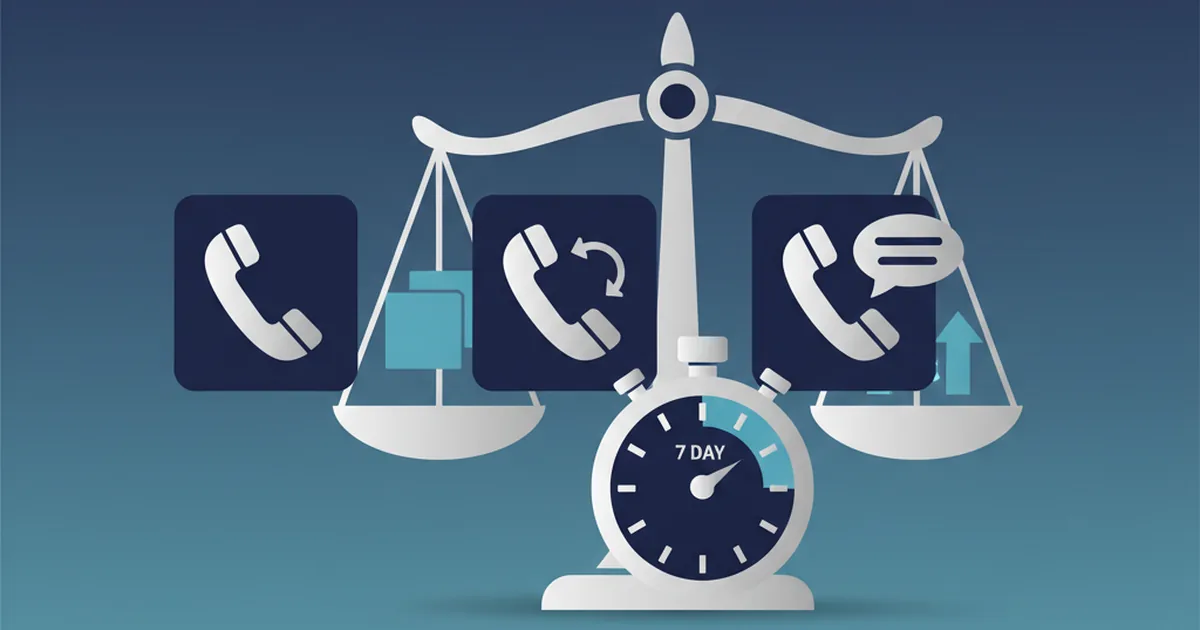
Quick answer. The 7-7-7 rule is a CFPB Regulation F presumption of compliance with the FDCPA prohibition on harassing calls. Under 12 CFR 1006.14(b), a debt collector who places no more than seven telephone call attempts within a seven-day period to a person about a particular debt, and waits at least seven days after a telephone conversation about that debt before placing the next call, is presumed compliant. Go over the count, and the presumption flips against you. For outsourced collections programs in 2026, the rule is a dialer-pacing, contact-attempt-counter, and audit-trail requirement, layered with TCPA and stricter state regimes. CFG is not a licensed collector. CFG fronters pre-qualify and warm-transfer to the client's licensed US collection staff, who own the 7-7-7 count.
Debt collection compliance in 2026 is not a single rule. It is a stack. At the federal floor sits the Fair Debt Collection Practices Act, 15 USC 1692, originally enacted in 1977. On top of the FDCPA, the CFPB issued Regulation F in 2020 (codified at 12 CFR Part 1006, with key call-frequency provisions becoming effective November 30, 2021), which gave the industry its first quantified call-attempt presumption: the so-called 7-7-7 rule. Parallel to that sits the TCPA, 47 USC 227, governing the technology used to dial. And layered on top of all of that are stricter state regimes including the New York Department of Consumer Affairs collections rules and the California Rosenthal Fair Debt Collection Practices Act. For outsourced collections programs, the 7-7-7 rule is the operational anchor most procurement and compliance teams ask about first. This piece walks what it actually says, what it requires operationally, where it overlaps with other layers, and how a fronter-and-warm-transfer outsourcing model fits.
What the 7-7-7 rule actually says
The rule lives at 12 CFR 1006.14(b), inside the CFPB's Regulation F implementing the FDCPA. The text gives a debt collector a safe-harbor presumption against the FDCPA prohibition on repeated or continuous telephone calls intended to annoy, abuse, or harass a person at a called number (the underlying FDCPA prohibition sits at 15 USC 1692d(5)).
The presumption has two parts, both of which have to be satisfied:
- Seven calls in seven days per debt. No more than seven telephone call attempts within a seven-day period to a particular person about a particular debt. Note: call attempts, not connected calls. A ring that goes to voicemail still counts as an attempt against the seven-in-seven cap.
- Seven-day cooling period after a telephone conversation. Once the collector has had a telephone conversation with the person about a particular debt, the collector cannot place another call to that person about that debt for seven days.
Two things to flag on the language. First, the unit is the debt, not the consumer. A collector working three separate debts owed by the same person can count each independently against its own 7-7-7 cap. Second, the rule is a presumption, not a hard ceiling. Going over the count does not automatically make a call unlawful. It flips the presumption: the collector now carries the burden of showing the calls were not intended to annoy, abuse, or harass. Most programs treat the count as a hard ceiling anyway, because the cost of litigating around a flipped presumption is higher than the cost of dialer-pacing controls.
Why the 7-7-7 rule matters for outsourced collections programs in 2026
If the collections work is done in-house on a single dialer instance with a single account-of-record, 7-7-7 enforcement is a configuration problem. If the work is split across an outsourced fronter team, an in-house licensed closer team, and a third-party predictive dialer vendor, the rule becomes a coordination problem. The count has to follow the debt across the seam, not get reset each time the call moves between systems.
For procurement and compliance teams evaluating outsourced collections vendors in 2026 (our free debt collection playbook covers the full vendor checklist), the 7-7-7 rule surfaces in five operational places:
- Dialer configuration. The dialer (in-house or vendor) needs a per-debt counter, not just a per-consumer counter, and it has to refuse to release a call when the count is at seven for the rolling seven-day window.
- Call-pace monitoring. Real-time dashboards that show consumers approaching the cap, plus alerts when an account is one attempt away. Reactive after-the-fact reporting is not enough.
- Contact-attempt tracking across channels. The 7-7-7 cap counts telephone call attempts only, but separate Regulation F rules on time of day, place, and consumer-elected inconvenient times (12 CFR 1006.6) still apply, and the system has to capture both.
- Audit trail. Every attempt logged with timestamp, debt identifier, agent identifier, disposition, and the dialer's pre-call count. CFPB examiners in compliance reviews routinely request these logs and they are also what plaintiff counsel asks for in FDCPA discovery.
- Vendor seam. If a vendor (fronter, dialer provider, skip-trace) touches the call, the contracts and the integration have to keep the 7-7-7 count synchronized with the licensed collector's system of record.
The buyer who skips any of these is buying litigation exposure with an offshore-rate discount on top.
How the rule interacts with TCPA and state-specific stricter rules
Treating 7-7-7 as a standalone rule is a common mistake. It is a federal floor under the FDCPA. Three other layers can apply at the same time.
TCPA, 47 USC 227. The TCPA governs the dialing technology, not the call-frequency presumption. A collector that uses an autodialer, a prerecorded or artificial voice, or that calls a cell phone without the right consent posture, has a TCPA problem regardless of whether the call count is one or seven. Conversely, manual-dialed calls with proper consent on a residential landline can still violate 7-7-7 if the count is exceeded. The two layers have to be satisfied in parallel.
New York Department of Consumer Affairs (DCA) collections rules. New York City's debt collection regulations under the DCA (now Department of Consumer and Worker Protection) impose stricter recordkeeping, disclosure, and licensing obligations than the federal floor. Collectors operating in New York City carry layered requirements on top of Regulation F, including specific itemization-date disclosures and language-access obligations.
California Rosenthal Fair Debt Collection Practices Act. Rosenthal (California Civil Code section 1788 et seq.) extends FDCPA-style consumer protections to first-party creditors as well as third-party collectors, which the federal FDCPA does not. A first-party servicer that would be exempt from the FDCPA can still be subject to Rosenthal in California.
Other states (Massachusetts, Colorado, Maryland, Washington, Connecticut, and others) layer additional restrictions. For multi-state programs, the dialer needs a per-state matrix, not a single global 7-7-7 setting. CFPB compliance examination manual context confirms that examiners look for evidence the collector has identified and complied with the most restrictive applicable regime for each consumer, not just the federal floor.
Operational controls every outsourced collections program needs
Whether the collections seat is in-house, nearshore, or far-offshore, the same set of operational controls has to be in place before a single dial leaves the system. Eight are non-negotiable:
- Dialer rate limit at the debt level. A per-debt counter that hard-stops at seven attempts inside a rolling seven-day window, plus a seven-day post-conversation cool-off timer keyed to the conversation timestamp.
- Per-state policy matrix. A rules engine that loads the consumer's state and applies the strictest applicable cap (federal vs. New York DCA vs. California Rosenthal vs. other state law) before the dialer releases the call.
- Time-of-day and time-zone guard. Calls only inside 8 a.m. to 9 p.m. local to the consumer (the FDCPA default under 15 USC 1692c(a)(1) and 12 CFR 1006.6(b)(1)(i)), with state-stricter overrides applied where required.
- Consumer-elected inconvenient time or place tracking. Honor every cease-communication request, every inconvenient-time election, and every employer-line restriction. Suppression list updates have to propagate to the dialer in near-real-time, not on a nightly batch.
- Supervisor monitoring ratios. Industry-typical compliance-heavy ratios run 1 supervisor per 10 agents on collections floors, versus 1:18 for unregulated outbound voice. Real-time silent monitoring on a sampled basis.
- Call recording and retention. Full-call recordings retained for the longer of the statute-of-limitations period in the consumer's state and the contractual retention term. Secure storage, encrypted at rest, with access logs.
- Escalation path. Documented script for when a consumer disputes, requests validation, invokes the FDCPA, asks for a supervisor, or references state-specific protections. Escalation has to leave the offshore fronter perimeter and route into the licensed US team.
- Audit-trail export. Per-debt, per-attempt log, exportable on demand for CFPB exams, state attorney general inquiries, FDCPA discovery, and internal compliance review.
Most of these are cheap to implement and expensive to retrofit. Buyers who inherit a program already running without them face a multi-quarter remediation effort.
How the fronter model fits collections programs in 2026
Here is where outsourcing positioning matters. CFG is not a licensed debt collector. CFG agents are fronters, not collectors. CFG does not collect debts directly and does not place 7-7-7 calls under its own name.
The fronter-and-warm-transfer model fits collections programs in a specific, narrow way. It is documented in full, market by market, on CFG's debt collection call center outsourcing hub. CFG fronters in Jamaica, Saint Lucia, Trinidad, Belize, Guyana, and Colombia handle the unregulated pre-qualification layer: confirming the consumer, identifying the right account holder, confirming basic context, and warm-transferring to the client's licensed US collection staff. The licensed US team owns the regulated portion: validation notice handling, dispute processing, payment negotiation, and the 7-7-7 call-frequency count under the client's account-of-record.
Practically, this means the FDCPA-relevant handling stays inside the client's US licensed perimeter. The offshore side of the program is a contact-rate and pre-qualification layer, not a collections layer. For 7-7-7 counting purposes, the call placed by the licensed US collector after the warm transfer is the call that counts against the cap, and the count lives in the client's licensed system of record. CFG's role is to feed warm, pre-qualified, right-party contacts into that system at native-English-speaker quality from same-timezone seats, at offshore-equivalent loaded cost.
Retention is worth more in collections than in almost any other program type, because every replacement is two weeks of FDCPA training before a seat is dial-ready. There is no published attrition series for the Caribbean or Latin America, so any band quoted for those markets, ours included, is a vendor estimate rather than a published measurement. What is defensible is the mechanism rather than a number: teams paying market-competitive wages on same-timezone daytime shifts with native English staffing hold tenure better than voice floors running inverted-circadian schedules. Our call center attrition guide sets out what the published data does and does not support by geography.
CFG operates with a Pilot Month from one agent, no setup fee, no annual prepay, and a seven-business-day ramp after a completed kickoff. The CFG outsourcing calculator models loaded cost against the buyer's current vendor. Operators running adjacent regulated-vertical front ends (for example, vetting Medicare call center outsourcing companies for AEP pre-qualification) apply the same fronter-and-licensed-closer model documented above.
Get the next collections compliance update
When CFPB, FCC, or state regulators publish new collections rules that change the operational stack, we send a short, plain-English note. No pitch. Unsubscribe anytime.
Sources
- Consumer Financial Protection Bureau. Regulation F, 12 CFR Part 1006. Debt Collection Practices. Call-frequency presumption at 12 CFR 1006.14(b). Communications in connection with debt collection at 12 CFR 1006.6.
- Fair Debt Collection Practices Act. 15 USC 1692 et seq. Prohibition on harassing telephone calls at 15 USC 1692d(5). Communication-with-consumer restrictions at 15 USC 1692c.
- Telephone Consumer Protection Act. 47 USC 227. Consent and autodialer provisions for calls to cell phones and residential lines.
- New York City Department of Consumer and Worker Protection (formerly DCA). Debt Collection Rules under Title 6 of the Rules of the City of New York, Subchapter M.
- California Civil Code section 1788 et seq. Rosenthal Fair Debt Collection Practices Act.
- Consumer Financial Protection Bureau. Supervision and Examination Manual, Debt Collection Examination Procedures.
Frequently Asked Questions
What is the 7-7-7 rule for debt collection?
The 7-7-7 rule is a presumption of compliance under CFPB Regulation F, 12 CFR 1006.14(b), implementing the Fair Debt Collection Practices Act (15 USC 1692). A debt collector who places no more than seven telephone call attempts within a seven-day period to a particular person about a particular debt, and who waits at least seven days after a telephone conversation about that debt before placing another call to that person, is presumed to comply with the FDCPA prohibition on repeated or continuous telephone calls intended to annoy, abuse, or harass.
Does the 7-7-7 rule apply to texts, emails, and voicemails?
No. The 7-7-7 frequency presumption in 12 CFR 1006.14(b) applies to telephone call attempts. Limited-content messages, voicemails left under the limited-content rule, texts, and emails are governed by separate provisions of Regulation F including 12 CFR 1006.6 and 1006.14. A collector still has to honor cease-communication requests and consumer-elected inconvenient times or places under 1006.6 regardless of the 7-7-7 telephone presumption.
Can states impose stricter call-frequency rules than the 7-7-7 rule?
Yes. The FDCPA and Regulation F set a federal floor, not a ceiling. New York Department of Consumer Affairs collections rules, the California Rosenthal Fair Debt Collection Practices Act, and similar regimes in other states can layer stricter call-frequency, content, time-of-day, and disclosure requirements on top of the federal rule. Multi-state collections programs need a per-state matrix in the dialer rather than a single 7-7-7 global setting.
How does the 7-7-7 rule interact with the TCPA?
The 7-7-7 rule is a Regulation F FDCPA presumption. The TCPA (47 USC 227) governs the technology used to place the call (autodialers, prerecorded voice, consent for cell phones). A collection program has to satisfy both layers in parallel. Staying inside the 7-7-7 count does not waive TCPA consent requirements, and TCPA-compliant dialing technology does not exempt a call from the 7-7-7 frequency presumption.
How does CFG handle debt collection programs given that it is not licensed?
CFG is not a licensed debt collector and CFG does not collect debts directly. CFG operates fronter-only teams in Jamaica, Trinidad, Saint Lucia, Belize, Guyana, and Colombia. Fronters handle unregulated pre-qualification and warm-transfer to the client's licensed US collection staff. All FDCPA-relevant handling (validation notices, dispute processing, payment negotiation, 7-7-7 call-frequency counting under the client's account-of-record) stays inside the client's US licensed perimeter on the receiving end of the warm transfer.
Outsourced collections, done right
Model the cost of a fronter-and-warm-transfer program
CFG runs fronter-only teams in Jamaica, Saint Lucia, Trinidad, Belize, Guyana, and Colombia. Native English, US Eastern overlap, warm-transfer to your licensed US collection staff. The 60-second CFG calculator compares your current vendor's loaded hourly against a Caribbean nearshore fronter team. Pilot Month from one agent, no setup fee, no annual prepay, live seven business days after a completed kickoff.
Already modeled it? Book a 20-minute discovery call.