Written and operationally reviewed by Miki Furman, Founder and CEO.
This article is general operational information for outsourcing buyers. It is not legal advice. Regulations change; consult your own counsel for compliance decisions.
Quick answer. Buyers often conflate "fronter" and "licensed agent" when scoping outsourced voice. They are different roles with different legal exposure. A fronter pre-qualifies and routes. A licensed agent makes binding statements about regulated products (insurance plans, Medicare enrollment, debt arrangements, securities recommendations). The fronter model lets you keep regulated handling inside your licensed US perimeter and move the unregulated pre-qualification offshore. Get the line wrong and you either over-buy licensed offshore coverage that does not actually solve the exposure or under-buy and let unlicensed reps touch regulated work.
This piece is for procurement leads scoping their first nearshore voice program and the general counsel teams reviewing the contract. The most common scoping error we see is one of two failure modes. Either the buyer asks the offshore vendor for "licensed agents" believing that is the safe path, then discovers that fully licensed offshore coverage in regulated verticals is either expensive, jurisdictionally complicated, or not actually available on the vendor's side. Or the buyer signs a generic outbound voice contract that does not name the fronter scope, then later finds out the offshore room is touching plan-specific Medicare conversations or quoting insurance rates. Both failure modes have the same root cause: the regulatory line was never drawn in the contract. This piece draws it.
What a fronter actually does (and does not do)
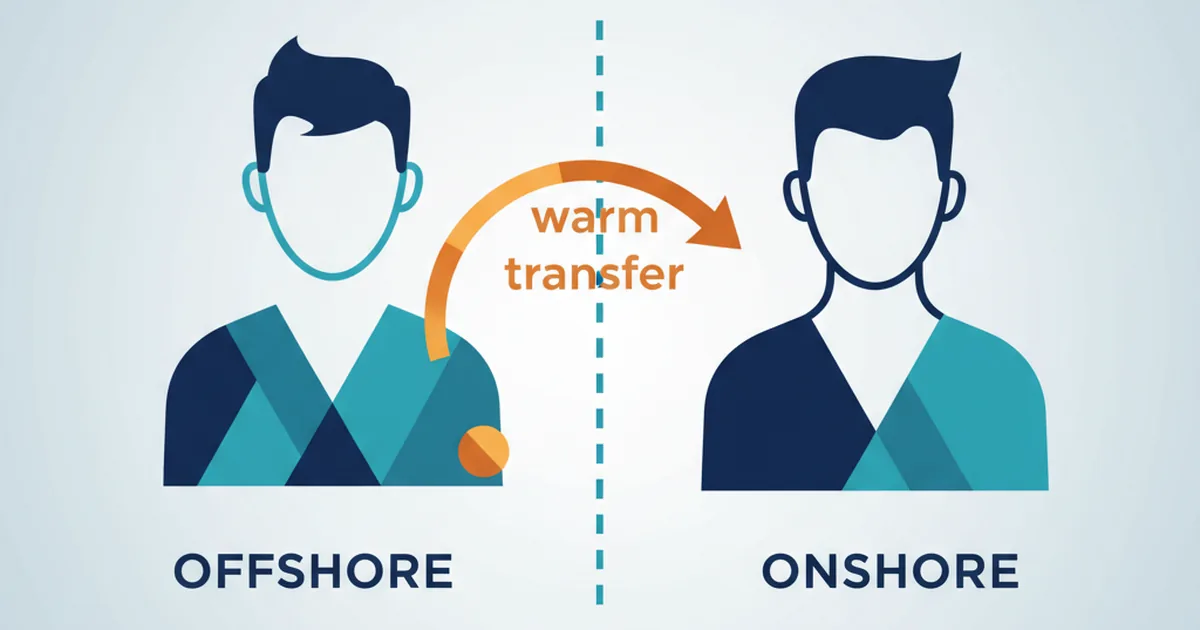
A fronter is a non-licensed outbound or inbound representative whose entire job is to confirm consumer intent, capture basic qualifying information, and route the call to a licensed party on the client's side. The fronter does not advise, recommend, quote regulated rates, or bind anything. In a properly scoped program, the fronter script never crosses into product-specific or rate-specific territory.
Concretely, a fronter is in scope for the following:
- Consent and identity. Confirming the consumer is on the call willingly, capturing TCPA-compliant consent where required (47 U.S.C. section 227), and verifying basic identifying information.
- Eligibility screening. Age, ZIP, employment status, debt amount band, prior coverage status, or whatever neutral qualifying criteria the client defines.
- Intent confirmation. Asking whether the consumer wants to speak with a licensed party about the topic they originally inquired about.
- Warm transfer. Routing the qualified consumer to the client's licensed US agent with a brief verbal handoff.
A fronter is out of scope for: quoting plan-specific premiums or benefits, recommending a specific product over another, providing investment advice, agreeing to debt settlement terms, binding insurance coverage, or any other activity that requires a credential the fronter does not hold.
What a licensed agent actually does
A licensed agent operates under a credentialing regime that authorizes them to make legally binding or regulated statements. The credential is product-specific and almost always jurisdiction-specific. Common examples:
- AHIP certification. Required annually for any party marketing Medicare Advantage or Part D plans, under CMS Medicare Communications and Marketing Guidelines (MCMG).
- State insurance producer license. Required under the NAIC producer licensing model law to solicit, negotiate, or bind insurance. Each state department of insurance issues and enforces the license.
- FINRA registrations. Series 6, 7, 63, 65, and 66 cover various categories of securities recommendation and investment advice under FINRA and SEC rules.
- State debt adjuster or debt settlement license. Required in many states to negotiate or arrange consumer debt settlement.
The credential carries both authority and exposure. A licensed party can make binding statements. They can also be personally disciplined (license suspension, fines, censure) for statements made on a call. That is the model the regulators built. The fronter sits one step away from that exposure surface by design.
Where the regulatory line sits in major verticals
The line is drawn differently in each regulated vertical. Procurement and general counsel teams should walk through the four below before scoping any offshore voice contract.
Medicare (AHIP plus CMS MCMG)
For Medicare Advantage and Part D, marketing and enrollment are governed by the CMS Medicare Communications and Marketing Guidelines. Plan-specific statements (comparing carriers, discussing premiums, copays, formularies, network providers, or enrolling a beneficiary) require AHIP certification and applicable state licensing. A fronter who confirms age, ZIP, and dual-eligible flag status (basic eligibility without plan-specific discussion) and warm-transfers to the client's AHIP-certified licensed US agent stays on the unregulated side of the line. Any conversation about specific plans, benefits, or enrollment must happen on the licensed side of the transfer.
Insurance (NAIC producer licensing)
Under the NAIC producer licensing model law and its state adoptions, soliciting, negotiating, or binding insurance requires a producer license issued by the relevant state department of insurance. The NAIC reciprocity framework allows non-resident licensing across states, but the underlying license is still issued by a US state to an individual or business entity meeting that state's requirements. A fronter who confirms intent and basic eligibility without quoting rates, recommending products, or binding coverage is outside the licensed producer scope. The licensed producer on the receiving end of the warm transfer handles the regulated activity. Carriers and agencies scoping the unregulated side of that split can read our deeper breakdown of insurance call center outsourcing services, including FNOL intake, renewal, and billing call types that sit cleanly outside producer licensing.
Financial Services (FINRA, SEC, GLBA)
FINRA registrations (Series 6 covering investment company products, Series 7 covering general securities, Series 63 covering state law, Series 65 covering investment adviser representatives, and Series 66 combining 63 and 65) govern who can recommend securities or provide investment advice under FINRA and SEC rules. The Gramm-Leach-Bliley Act (GLBA) governs the handling of nonpublic personal financial information. A fronter who routes consumers to a registered representative or investment adviser, without making product recommendations or strategy advice, stays outside the licensed-rep scope. GLBA handling obligations still apply to the fronter as a service provider, which is why fronter teams running financial verticals operate under specific data-handling controls.
Healthcare (HIPAA covered entity vs business associate)
HIPAA (45 CFR section 164) distinguishes between covered entities (health plans, healthcare providers, healthcare clearinghouses) and business associates (vendors who handle protected health information on behalf of a covered entity). A fronter handling PHI for a covered entity client is a business associate and operates under a business associate agreement. The fronter is not authorized to provide medical advice or make clinical decisions. The line in healthcare is less about credentials and more about role: clinical judgement and PHI disclosure beyond the BAA scope must stay with the covered entity. For procurement teams scoping the BAA, safeguards, and breach-notification flow-down, our guide to HIPAA compliance requirements for outsourcing healthcare walks through the 45 CFR 164 controls a covered entity should verify before the first PHI touch.
Why this matters for offshore voice in 2026
The September 2024 FCC declaratory ruling under CG Docket No. 02-278 expanded location-disclosure obligations on offshore-originated calls in regulated verticals. It did not prohibit offshore voice. It made the documented cost of running far-offshore voice in regulated work more visible to procurement teams and their general counsel.
In that environment, the fronter model gets cleaner, not messier. The cleanest possible scope for an offshore voice room is one that does no regulated handling at all. Pre-qualification, intent confirmation, warm transfer. Period. The licensed work (rate quoting, plan enrollment, binding adjustments, securities recommendations, clinical decision-making) sits onshore with the client's credentialed staff. The disclosure obligations under the FCC ruling apply to the offshore-originated portion of the call, which (in a properly scoped fronter program) is the unregulated portion.
This is why buyers who try to procure "licensed offshore coverage" in regulated verticals usually end up unhappy. Either the credentials are jurisdictionally limited in ways that do not match the client's footprint, or the licensed offshore party is harder to discipline if something goes wrong on a call, or the disclosure burden under the FCC ruling makes the math worse, not better. The fronter model sidesteps all three problems by design.
How CFG's fronter-only model fits
CFG operates strictly as a fronter. We do not hold AHIP certification, state insurance producer licenses, FINRA registrations, state debt adjuster licenses, or any other licensed-agent credentials. Our teams in Jamaica, Saint Lucia, Trinidad, Belize, Guyana, and Colombia (with HQ in Toronto) pre-qualify consumers and warm-transfer to the client's licensed US closers. That is the entire scope of the offering.
This is not a limitation. It is the operating model. CFG's compliant scope is the feature procurement and general counsel teams should be evaluating when they look at us. We do not stretch into regulated handling because the moment we did, the buyer's exposure surface would expand. The point of contracting a fronter is to keep the licensed perimeter intact onshore. We respect that perimeter as a precondition of the engagement.
Caribbean nearshore (Jamaica, Saint Lucia, Trinidad, Belize, Guyana, Colombia) gives the buyer same-time-zone US Eastern overlap, native English from the Caribbean and bilingual English-Spanish agents in Colombia, and a wage structure that is competitive with local labor markets rather than dependent on labor-arbitrage discount. On retention, be careful what you accept as data: there is no published attrition series for the Caribbean or Latin America, so any band quoted for those markets, ours included, is a vendor estimate rather than a published measurement. Our call center attrition guide sets out what the published data does and does not support. For buyers comparing geographies, our reference on the best nearshore customer service locations for US companies 2025 to 2026 ranks the operating cohorts side by side. None of that changes the regulatory analysis. CFG is a fronter, and the licensed work sits with the client.
Buyers can start with a Pilot Month from one agent: no setup fee, no annual prepay, and live seven business days after a completed kickoff. The CFG outsourcing calculator runs a 60-second comparison so buyers can see how a fronter-only program compares against their current vendor stack.
Get the next compliance brief
When the FCC, CMS, NAIC, or FINRA publish a change that affects offshore voice scoping, we send a short brief. No pitch. Unsubscribe anytime.
Sources
- Federal Communications Commission. Declaratory Ruling, CG Docket No. 02-278. September 2024.
- Centers for Medicare and Medicaid Services. Medicare Communications and Marketing Guidelines (MCMG).
- America's Health Insurance Plans. AHIP Medicare Training and Certification.
- National Association of Insurance Commissioners. Producer Licensing Model Act.
- Financial Industry Regulatory Authority. FINRA Qualification Examinations (Series 6, 7, 63, 65, 66) and Securities and Exchange Commission rules.
- US Department of Health and Human Services. HIPAA Privacy and Security Rules, 45 CFR Part 164, covered entity and business associate framework.
- US Code. Telephone Consumer Protection Act, 47 U.S.C. section 227.
Frequently Asked Questions
What is the difference between a fronter and a licensed agent?
A fronter pre-qualifies a consumer and routes the call to a licensed party. A licensed agent makes binding statements about regulated products, such as Medicare plan enrollment, insurance binding, debt arrangement terms, or securities recommendations. The two roles carry different legal exposure. A fronter handles unregulated pre-qualification only. A licensed agent operates under credentialing regimes (AHIP, state insurance licensing under NAIC model law, FINRA registration) and can make statements that legally bind the consumer or the client.
Where does the Medicare regulatory line sit?
For Medicare Advantage and Part D, marketing and enrollment are governed by the CMS Medicare Communications and Marketing Guidelines (MCMG) and require AHIP certification and applicable state licensing for any party making plan-specific statements, comparing plans, or enrolling beneficiaries. A fronter who only verifies basic eligibility (age, geographic ZIP, dual-eligible status flags) and warm-transfers to the client's licensed US agent stays on the unregulated side of the line. Plan-specific discussion, comparison, or enrollment must sit with the AHIP-certified, state-licensed party.
Where does the insurance regulatory line sit?
State insurance departments, operating under the NAIC producer licensing model law, require a producer license for anyone soliciting, negotiating, or binding insurance. A fronter who confirms intent and basic information without quoting rates, recommending products, or binding coverage is generally outside the licensed-producer scope. The licensed producer on the receiving end of the warm transfer handles the regulated activity.
Where does the financial services regulatory line sit?
FINRA (Series 6, 7, 63, 65, 66) and SEC rules govern who can recommend securities or provide investment advice. GLBA governs the handling of nonpublic personal financial information. A fronter who collects consent and routes consumers to a registered representative or investment adviser stays outside the licensed-rep scope, provided the fronter does not make specific product recommendations or advise on investment strategy.
Does CFG hold AHIP, state insurance, or FINRA credentials?
No. CFG is a fronter and does not hold AHIP certification, state insurance producer licenses, FINRA registrations, or any other licensed-agent credentials. CFG pre-qualifies offshore in Jamaica, Saint Lucia, Trinidad, Belize, Guyana, and Colombia, with HQ in Toronto, and warm-transfers consumers to the client's licensed US agents. This is the entire scope of the offering and a feature of the compliant operating model, not a limitation.
Scope a compliant fronter program
Keep the licensed work onshore. Move the rest.
CFG runs fronter-only teams in Jamaica, Saint Lucia, Trinidad, Belize, Guyana, and Colombia with HQ in Toronto. Native English, US Eastern overlap, warm-transfer to your licensed US closers. The 60-second CFG calculator compares your current vendor's loaded hourly against a compliant fronter scope. Pilot Month from one agent, no setup fee, no annual prepay, live seven business days after a completed kickoff.
Already scoped it? Book a 20-minute discovery call.